How Often Commercial Carpet Needs Cleaning Depends on Traffic
Commercial carpet runs on three schedules: vacuuming, interim cleaning and deep cleaning by hot water extraction. Manufacturers generally call for deep cleaning about once or twice a year in light-traffic areas like private offices, and 3 to 6 times a year in heavy-traffic entrances, hallways and breakrooms. Vacuuming runs from a few times a week to daily.
TLDR:
- There is no single answer. Carpet makers set cleaning frequencies by traffic level, room by room.
- Light traffic, like private offices: vacuum 2 or more times a week and deep clean about once a year.
- Heavy traffic, like entrances and break rooms: vacuum at least daily and deep clean 3 to 6 times a year.
- Interim cleaning between deep cleans keeps heavy-traffic carpet from falling behind.
- Entry mats of 9 to 15 feet can trap about 80% of the soil and moisture that would reach the carpet.
- Skipping the manufacturer’s maintenance program, or using the wrong method, can cost you the warranty.
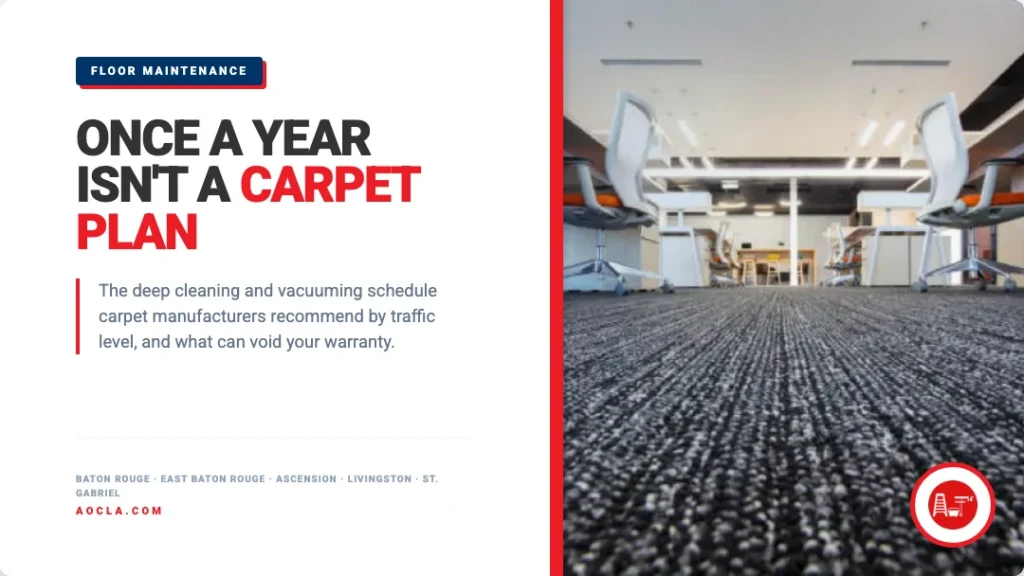
Many facilities put carpet on a single calendar: clean it once a year and hope. That works for a quiet executive suite. It does not work for the carpet inside a front door or down a main hallway, which takes most of the building’s traffic.
The companies that make commercial carpet publish their own cleaning schedules, and they all sort the building by traffic first. This guide lays out what they recommend and how to turn it into a plan.
Is your carpet on the right schedule?
Advanced Office Care has maintained Baton Rouge commercial floors since 2006. We will walk your space, sort it by traffic, and build a carpet schedule that fits how the building is actually used.
What Are the Three Kinds of Carpet Cleaning?
Carpet care is not one job. The manufacturers split it into three, each on its own clock.
- Vacuuming removes loose, dry soil before it grinds into the fibers. The Carpet and Rug Institute’s standard says “79% or more of the soil can be removed dry by vacuuming.”
- Interim cleaning is a lighter, low-moisture cleaning of traffic lanes between deep cleans, to keep appearance up.
- Deep or restorative cleaning pulls out embedded soil. Interface calls hot water extraction “the most effective method and the only restorative method recommended by Interface.”
Most “how often” confusion comes from mixing these up. A building can be vacuumed daily and still be overdue for extraction.
What Do Carpet Manufacturers Recommend?
They agree on the pattern, and the numbers are close. Here is how three major commercial carpet makers set deep cleaning (hot water extraction) by traffic level:
| Traffic level | Shaw Contract (2022) | Interface (2026) | Tarkett (2019) |
|---|---|---|---|
| Light (private offices, cubicles) | 1 time per year | 1 to 2 times per year | Every 6 months |
| Moderate (shared offices, conference rooms) | 2 times per year | 2 to 4 times per year | Every 3 months |
| Heavy (entrances, main halls, break rooms) | 4 times per year | 3 to 6 times per year | Every 2 months |
Sources: Shaw Contract’s carpet maintenance checklist, Interface’s carpet tile maintenance guidelines (revised March 2026) and Tarkett’s modular care program. Tarkett adds that its frequencies “are suggested starting points only,” and each maker defines traffic levels a little differently.
The Carpet and Rug Institute’s CRI 204 commercial maintenance standard (2023 edition) lands in the same range: deep cleaning “1-2x annually” for moderate traffic and “2-6x annually” for heavy traffic, with more frequent cleaning in soil-prone areas.
The takeaway: once a year is the floor for your quietest space, not a plan for the whole building.
How Often Should Commercial Carpet Be Vacuumed?
More often than it is deep cleaned, and again by traffic. CRI 204 says “private offices, meeting rooms, and boardrooms can be vacuumed on a two or three-times-per-week schedule,” while entrance areas get vacuumed daily at every traffic level.
The manufacturers agree. Shaw Contract calls for vacuuming private offices and cubicles “2+ times per week,” shared offices and conference rooms “1 time per day,” and entrances, main hallways and break rooms “1+ times per day.” Interface’s heavy-traffic row reads “Daily in traffic areas. Overall 4 to 7x per week.”
The U.S. Environmental Protection Agency ties this to indoor air. Its guidance on carpet and indoor air quality says carpet can trap particles, “which can be removed through regular and effective vacuuming.”
Want a carpet schedule by room, not by calendar?
Tell us about your building’s entrances, hallways and offices. We will set vacuuming, interim and deep cleaning for each zone, in writing.
Why Entry Mats Change the Whole Schedule
Tarkett’s guide says “Virtually all of the soil in a facility is tracked in from the outside,” so the cheapest way to stretch a cleaning schedule is to stop it at the door. CRI 204 says “Mats that extend for 9 to 15 feet inside the entrance will trap eighty percent of soil and moisture from the first five or six steps.”
Interface puts it the same way: “At 15 feet, these mats can effectively remove 80% of soil and moisture before they reach the carpet.” Shaw Contract says mats “should cover at least 6 footsteps.”
A small rug at the door falls well short of that. If your entrance carpet is always the first thing to look worn, the matting is usually the first place to look.
Can the Wrong Cleaning Void Your Carpet Warranty?
Yes, and this is where many facilities get caught. CRI 204 warns that “Failure to follow this standard or the carpet manufacturer’s maintenance guidelines may result in the loss of warranty coverage and/or reduction in long-term performance.”
The warranties say so directly. Shaw Contract’s carpet tile warranty states, “Damage resulting from a failure to follow installation and cleaning/maintenance guidelines will not be covered under this warranty.” Mohawk Group’s ten-year stain warranty requires carpet maintained “in strict accordance with Mohawk Group’s instructions and procedures.”
Method matters as much as frequency. Interface’s guide says rotary or bonnet cleaning “MAY VOID ALL WARRANTIES,” and Tarkett says the spin bonnet “is prohibited” on its soft surface products. Before you hire anyone, ask what equipment they use, and keep a record of each cleaning so you can prove the carpet was maintained.
Why Drying Time Matters in a Humid Building
Deep cleaning puts water into the carpet, and it has to come back out. EPA warns that “If carpeting remains damp, it can become a primary source for microbial growth,” which is a real concern in Louisiana’s humid climate.
The manufacturers build drying into the procedure. Interface says to keep the HVAC on and use air movers during and after cleaning, and to “PLAN ON A MINIMUM OF 3 HOURS UNDER NORMAL CONDITIONS,” with no foot traffic until the carpet is dry. Schedule extraction for evenings or weekends, and make sure the building’s air conditioning stays on afterward.
Building a Carpet Schedule for Your Facility
Turn the tables above into a plan by zone. For a typical Baton Rouge office building, that looks like this:
- Entrances, main hallways, break rooms: vacuum at least daily, interim clean monthly, deep clean 3 to 6 times a year
- Shared offices and conference rooms: vacuum daily or several times a week, deep clean about twice a year
- Private offices and cubicles: vacuum 2 to 3 times a week, deep clean about once a year
- Entry matting: 9 to 15 feet inside each main entrance, vacuumed daily (Tarkett’s walk-off guidance)
Then check your carpet’s own maintenance guide. If the manufacturer’s numbers are stricter, follow them, since they are what the warranty is written against. Our commercial floor maintenance guide covers the hard floors that usually share the building with your carpet.
Common Questions About Commercial Carpet Cleaning Frequency
These are the questions Baton Rouge facility managers ask when they set a carpet schedule or compare bids. The answers follow the carpet manufacturers’ published guides and the Carpet and Rug Institute’s CRI 204 standard.
How often should commercial carpet be professionally cleaned?
It depends on traffic. Manufacturers generally recommend deep cleaning light-traffic carpet, like private offices, once or twice a year, moderate-traffic areas two to four times, and heavy-traffic entrances and hallways three to six times. Tarkett calls for monthly extraction in walk-off areas.
How often should office carpet be vacuumed?
The Carpet and Rug Institute’s CRI 204 standard sets private offices and meeting rooms at two or three times a week. Entrances, main hallways and break rooms should be vacuumed at least daily. Vacuuming removes most dry soil before it grinds into the fibers.
What is the difference between interim and deep carpet cleaning?
Interim cleaning is a lighter, low-moisture cleaning of traffic areas between deep cleans, to keep appearance up. Deep or restorative cleaning, usually hot water extraction, removes embedded soil. Interface calls hot water extraction the only restorative method it recommends, so ask any vendor which method they use.
Can the wrong carpet cleaning method void the warranty?
It can. Carpet warranties typically require maintenance that follows the manufacturer’s guidelines, and some makers specifically warn against bonnet or rotary cleaning. Interface says it may void all warranties, and Tarkett prohibits the spin bonnet on its soft surface products.
How long should carpet take to dry after cleaning?
Interface says to plan on at least three hours under normal conditions, with HVAC running and air movers in use, and no foot traffic until the carpet is dry. In a humid building, drying fast matters, since damp carpet can grow microbes.
Do entry mats really reduce carpet cleaning?
Yes. The Carpet and Rug Institute says mats extending 9 to 15 feet inside an entrance trap about 80 percent of the soil and moisture from the first five or six steps. That soil never reaches the carpet, so it does not have to be cleaned out later.
About Advanced Office Care
Advanced Office Care is a family-owned commercial cleaning company serving Baton Rouge and surrounding areas since 2006, owned by Clay and Nessa Vavasseur. We clean offices, medical facilities, churches, schools and childcare centers across East Baton Rouge, Ascension, Livingston, West Baton Rouge, Iberville and St. Tammany Parishes.
Our commercial carpet cleaning in Baton Rouge and floor maintenance services are scheduled by traffic zone, so busy areas get the attention they need. Questions first? Call (225) 751-7388.
Ready for a carpet plan that protects the warranty?
Tell us about your building. We will set a schedule by traffic zone, use methods your carpet maker approves, and give you a clear quote with no surprises.