Norovirus Needs a Different Cleaning Protocol Than Flu
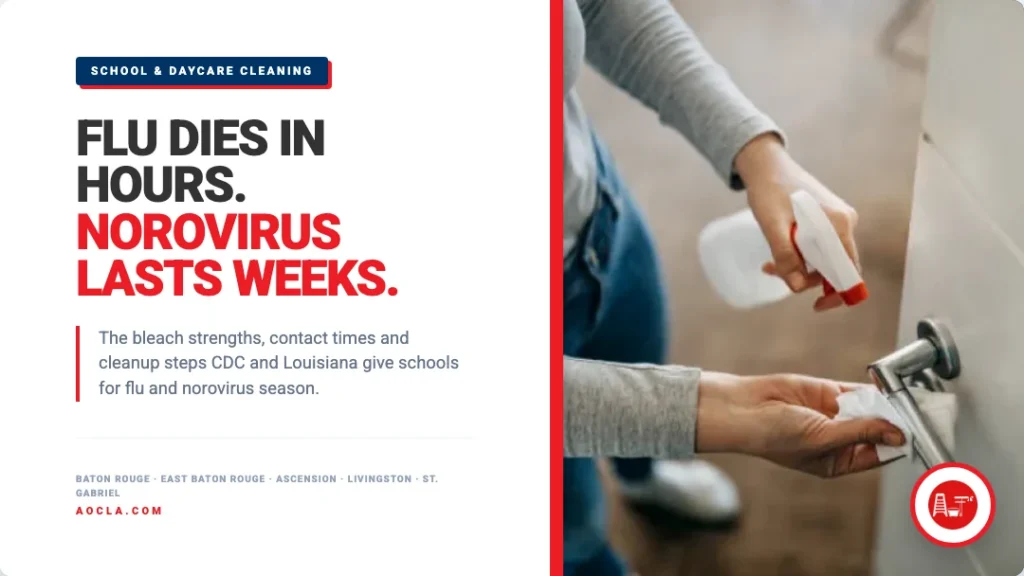
Flu and norovirus need different plans. CDC says flu virus survives only 2 to 8 hours on a surface and standard cleaning handles it. Norovirus lasts far longer, hand sanitizer does not work well against it, and CDC calls for a 1,000 to 5,000 ppm bleach solution or an EPA List G product left wet for the full contact time. Write both protocols down before the season starts.
TLDR:
- Flu is fragile: CDC says routine cleaning and disinfecting are enough, and special fumigating is not recommended.
- Norovirus is tough: dried virus can persist for weeks, and it survives in carpet.
- CDC’s norovirus bleach range is 1,000 to 5,000 ppm, which is 5 to 25 tablespoons of household bleach per gallon.
- Louisiana’s guidelines call for 10 to 20 minutes of contact time and full protective gear for norovirus cleanup.
- Vomit cleanup is a written, step-by-step job, not a mop-and-go.
- Louisiana requires any disease outbreak to be reported within 24 hours.
Baton Rouge schools and daycares get both seasons at once. CDC says flu most often peaks between December and February, and norovirus outbreaks are most common from November to April. From late fall on, a single vomiting incident in a classroom can turn into a building-wide absence problem.
The fix is not more cleaning. It is the right chemistry, the right contact time and a cleanup routine everyone follows the same way.
Is your cleaning scope ready for norovirus season?
Advanced Office Care has served the Baton Rouge area since 2006 and cleans schools and childcare centers across the Capital Region. We will put the disinfectant, the dilution and the contact time in writing, so your staff and ours follow the same protocol.
When Do Flu and Norovirus Season Hit Louisiana Schools?
The two seasons overlap for most of the school year. CDC’s flu season page says “most of the time flu activity peaks between December and February.” CDC’s norovirus outbreak overview says outbreaks “are most common from November to April.”
Schools feel it most. A 2022 study in Pediatrics counted 2,623 school and 1,972 childcare gastroenteritis outbreaks reported from 2009 to 2019, and found that “Norovirus was the leading pathogen in school outbreaks,” at 64.4%.
That is why the protocol should be written before November, not after the first call home.
The Flu Protocol: Routine Cleaning, Done Consistently
Flu is the easier of the two. CDC’s school guide, How to Clean and Disinfect Schools to Help Slow the Spread of Flu (August 2016), says “the flu virus can live and potentially infect a person for only 2 to 8 hours after being deposited on a surface.”
It adds that flu viruses are “relatively fragile, so standard cleaning and disinfecting practices are sufficient to remove or kill them.” Wiping walls and ceilings, room deodorizers and fumigating “are not necessary or recommended.”
What CDC does recommend is daily attention to the surfaces hands share, which it lists as “desks, countertops, doorknobs, computer keyboards, hands-on learning items, faucet handles, phones, and toys.” For a homemade disinfectant, it gives ¼ cup of bleach per gallon of water and says to “Let it stand for 3 to 5 minutes.” Our flu prevention strategies for Louisiana schools cover the rest of the flu-season plan.
The Norovirus Protocol: Stronger Chemistry, Longer Contact
Norovirus is a different problem. CDC’s norovirus data page calls it “the leading cause of vomiting and diarrhea” from acute gastroenteritis in the United States, and it does not behave like flu on a surface.
CDC’s evidence review for its healthcare norovirus guideline says the virus “can persist in a dried state at room temperature for up to 21-28 days,” and may remain viable “in carpets up to 12 days, despite regular vacuuming.”
It also resists the tools schools lean on. CDC’s norovirus prevention guidance says “Hand sanitizer does not work well against norovirus,” and calls for handwashing with soap and water instead. For surfaces, it says to use “a chlorine bleach solution with a concentration of 1,000 to 5,000 ppm (5 to 25 tablespoons of household bleach [5% to 8%] per gallon of water) or use an EPA-registered disinfecting product against norovirus.”
Here is how the two protocols compare:
| Flu (routine) | Norovirus | |
|---|---|---|
| Survival on surfaces | 2 to 8 hours (CDC) | Up to 21 to 28 days dried (CDC evidence review) |
| Bleach solution | ¼ cup per gallon (CDC) | 1,000 to 5,000 ppm, 5 to 25 tbsp per gallon (CDC) |
| Contact time | 3 to 5 minutes (CDC) | At least 5 minutes (CDC); 10 to 20 minutes (Louisiana) |
| Special cleaning | Not needed (CDC) | Enhanced cleaning during an outbreak (CDC) |
By our math, CDC’s flu mix of ¼ cup is 4 tablespoons per gallon, which falls below the 5-tablespoon bottom of its norovirus range. A bucket mixed for flu season is not a norovirus disinfectant.
Want your disinfectant and dilution in writing?
We will spell out the product, the strength and the contact time for routine days and outbreak days, so there is no guessing when a child gets sick.
What Louisiana’s Health Department Adds
Louisiana’s Office of Public Health publishes its own norovirus cleaning and disinfection guidelines (revised 2018), and they are more specific than CDC’s. They list three bleach strengths:
- 200 ppm, 1 tablespoon of bleach per gallon, for stainless steel, food and mouth contact items, and toys
- 1,000 ppm, 1/3 cup of bleach per gallon, for non-porous surfaces, tile floors, countertops, sinks and toilets
- 5,000 ppm, 1 cup plus 2/3 cup of bleach per gallon, for porous surfaces and wooden floors
The Louisiana guidelines set contact time at 10 to 20 minutes, followed by a rinse with clean water. They also say to prepare a fresh dilution every day of use and discard what is left, since open bleach loses strength.
For products other than bleach, EPA’s List G names disinfectants for which “EPA has reviewed required laboratory testing data demonstrating that these products kill norovirus.” Every product has its own contact time on the label, and CDC’s facility cleaning guidance says “The surface should stay wet during the entire contact time.”
How Should Staff Clean Up Vomit or Diarrhea?
A quick, thorough cleanup keeps one sick child from becoming an outbreak. CDC’s prevention page gives five steps:
CDC’s exact wording starts with “Wear rubber or disposable gloves and wipe the entire area with paper towels and throw them in a plastic trash bag.” After the bleach sits, it says to “Clean the entire area again with soap and hot water,” then wash laundry, take out the trash and wash hands.
Louisiana’s guidelines go further. They call for “Disposable gloves, masks, eye protection or face shields, and gown or protective clothing,” and say to “Liberally disinfect area and objects surrounding the contamination.” They also warn against applying any disinfectant with a spray bottle.
Carpet and rugs need heat, not just bleach. The Louisiana guidelines say to steam clean at 158°F for 5 minutes or 212°F for 1 minute, since bleach may discolor carpet.
Toys, Nap Areas and Diaper Stations
Early learning centers carry extra risk because small children put everything in their mouths. The school and daycare section of the Louisiana guidelines says “Toys should be cleaned and disinfected daily,” and that toys that go in a child’s mouth “must be disinfected with 200ppm bleach, rinsed thoroughly and air dried,” or run through a high-temperature dishwasher.
Diaper changing surfaces get cleaned after every change. The guidelines call for a disposable cover on the pad and a detergent, water and friction wash after each use, followed by handwashing for the caregiver and the child.
Our school and daycare cleaning guide for Baton Rouge administrators covers the daily licensing standard these outbreak steps sit on top of.
What Does Louisiana Require When an Outbreak Starts?
Reporting comes first. Under the Louisiana Sanitary Code, LAC 51:II.105, “any disease outbreak, shall be reported to the Office of Public Health as soon as possible but no later than 24 hours from recognition.” LAC 51:II.113 puts reportable-disease duties on the “principal of a public or private school” and the “operator of a day care center.”
Cleaning escalates too. CDC’s everyday actions guidance for schools says a school may need enhanced cleaning when “an outbreak occurs with a specific pathogen like norovirus,” and says schools “should consult with their state or local health department” about what cleaning is needed.
This article is general guidance, not a substitute for your health department. When an outbreak starts, follow the Office of Public Health’s instructions for your building.
Writing the Protocol Into Your Cleaning Scope
A protocol only works if everyone knows who does what. Many incidents happen during the school day, when the cleaning crew may not be on site.
Put these answers in writing before November:
- Which disinfectant is used for routine days, and which for norovirus, with the dilution and contact time for each
- Who mixes bleach solutions, and that a fresh batch is made each day of use
- Where the spill kit lives, and what is in it: gloves, masks, eye protection, gowns, absorbent material and bags
- Who handles a daytime vomiting incident, and what the evening crew does to follow up
- What enhanced cleaning looks like during an outbreak, and who approves it
Never mix cleaners. CDC’s school guide warns that “Combining certain products (such as chlorine bleach and ammonia cleaners) can result in serious injury or death.” Our guide to a commercial cleaning scope of work in Louisiana shows how to lay out duties like these.
Common Questions About Norovirus and Flu Cleaning in Schools
These are the questions school and daycare administrators ask once the first stomach bug hits. The short answers follow CDC and Louisiana Office of Public Health guidance.
What kills norovirus on school surfaces?
CDC recommends a chlorine bleach solution of 1,000 to 5,000 ppm, which is 5 to 25 tablespoons of household bleach per gallon of water, or an EPA-registered product on List G. Leave bleach on for at least 5 minutes. Louisiana’s guidelines call for 10 to 20 minutes.
Does hand sanitizer work against norovirus?
Not well. CDC says hand sanitizer does not work well against norovirus and is not a substitute for handwashing. During norovirus season, students and staff should wash with soap and water, especially after using the restroom and before eating.
How long does norovirus last on surfaces?
Much longer than flu. A CDC evidence review says norovirus can persist in a dried state at room temperature for up to 21 to 28 days, and in carpet for up to 12 days despite vacuuming. CDC’s school guide says flu virus survives only 2 to 8 hours.
Is our flu-season bleach mix strong enough for norovirus?
Probably not. CDC’s school flu recipe is ¼ cup of bleach per gallon, which is 4 tablespoons. CDC’s norovirus range starts at 5 tablespoons per gallon, and Louisiana’s hard-surface strength is 1/3 cup per gallon. Mix a separate, stronger batch for norovirus.
How should a school clean up after a child vomits?
Glove up, wipe the whole area with paper towels and bag them, disinfect with a norovirus-strength product, leave it for the full contact time, then clean again with soap and hot water. Louisiana’s guidelines add masks, eye protection and a gown, and say to disinfect the surrounding area.
Does a Louisiana school have to report a norovirus outbreak?
Yes. The Louisiana Sanitary Code requires any disease outbreak to be reported to the Office of Public Health no later than 24 hours from recognition. School principals and daycare operators carry reporting duties for reportable diseases in their buildings.
About Advanced Office Care
Advanced Office Care is a family-owned commercial cleaning company serving Baton Rouge and surrounding areas since 2006, owned by Clay and Nessa Vavasseur. We clean offices, medical facilities, churches, schools and childcare centers across East Baton Rouge, Ascension, Livingston, West Baton Rouge, Iberville and St. Tammany Parishes.
Our school cleaning services in the Baton Rouge area and daycare cleaning in Baton Rouge are built around written frequencies and written protocols. Questions first? Call (225) 751-7388.
Ready for a norovirus plan you can hand to your staff?
Tell us about your school or center. We will put the disinfectants, dilutions and contact times in writing, show you exactly what is covered, and give you a clear quote with no surprises.