School and Daycare Cleaning in Baton Rouge Starts With the Licensing Standard
Louisiana requires every licensed early learning center to sanitize cots, cribs and mats daily and launder bedding at least weekly, under Bulletin 137. K-12 schools are exempt from that bulletin and follow district specs instead. Most cleaning problems in both settings are scope problems, not effort problems: the contract never wrote the required frequencies down.
TLDR:
- Bulletin 137 sets the cleaning floor for licensed early learning centers: cots, cribs and mats sanitized daily, bedding laundered at least weekly.
- Soiled disposable diapers leave the building every day, and gloves, tissues and wipes that touch body fluids are discarded after each use.
- Public and non-public K-12 schools, including their attached pre-K, are exempt from Bulletin 137. Their specs come from the district or the school.
- An auditable scope uses frequencies (“sanitized daily”), not adjectives (“kept clean”).
- Handwashing at 13 required moments makes soap, towels and restocking a vendor obligation.
- A 10-question checklist separates a vendor who knows licensed childcare from one who only knows offices.
Plenty of Baton Rouge administrators inherit a cleaning contract they did not write. A daycare director takes over a center, or a school business manager takes over a building, and the scope of work is whatever the last person signed.
That works until an inspection, a parent complaint, or a stomach bug running through the three-year-old room. Then the question becomes what the vendor was actually obligated to do, and the contract rarely says. This guide gives you the standard, the scope language, and the vendor questions.
Want a cleaning scope written around the standard you are licensed against?
Advanced Office Care has cleaned Baton Rouge-area facilities since 2006. We build school and daycare scopes with the required frequencies spelled out before anyone signs.
What Louisiana Actually Requires of a Licensed Early Learning Center
The cleaning rules for licensed childcare in Louisiana live in one document: Title 28, Part CLXI of the Louisiana Administrative Code, better known as Bulletin 137. Every citation below comes from the April 2025 edition of Bulletin 137, read directly rather than from a summary.
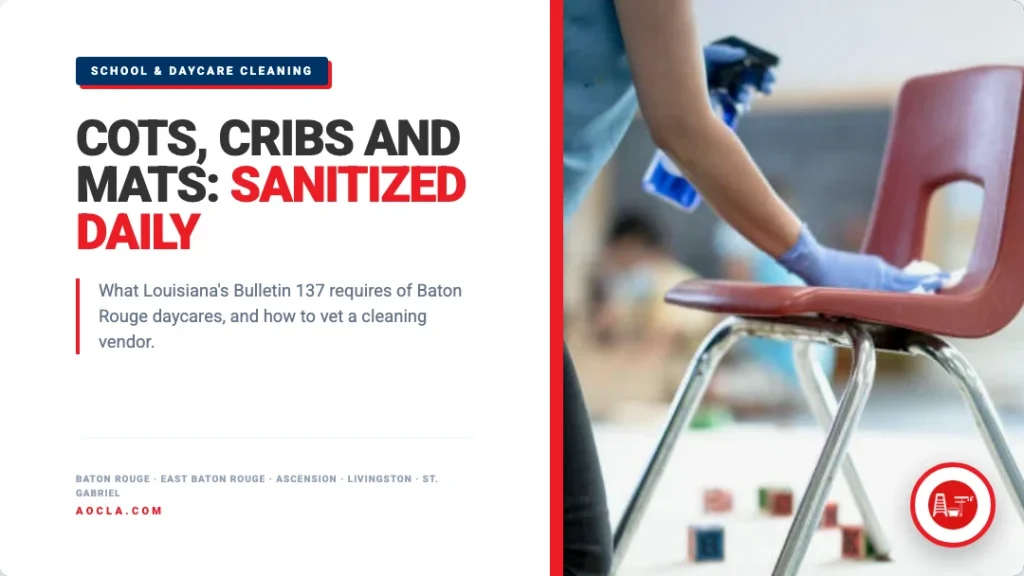
The most specific cleaning requirement is about sleep. Per §1907.C.2 of the Louisiana Administrative Code, sleeping spaces are assigned to each child permanently and labeled, “and the cots, cribs and mats shall be sanitized daily.” The same section requires sheets to be changed immediately when soiled or wet and routine laundering at least weekly.
Here is the full set of cleaning-related requirements, with section numbers you can hand to a vendor:
| Section | What it requires |
|---|---|
| §1907.C.2 | Cots, cribs and mats sanitized daily |
| §1907.D.2 | Sheets and coverings changed immediately when soiled or wet |
| §1907.D.3 | Routine laundering at least weekly |
| §1901.G | All equipment used by children kept clean, safe and in good repair |
| §1901.J | Cleaning supplies and chemicals kept in a locked cabinet or other secure place, inaccessible to children |
| §1901.S.1-2 | Gloves, tissues, paper towels and wipes that touch a biocontaminant discarded after each use |
| §1901.S.3 | Soiled disposable diapers in a lined, closed container, removed to a closed outdoor receptacle daily |
| §1911.K | Staff and children wash hands with soap at 13 listed moments |
Read the table as a floor, not a finished scope. It tells you what the licensing standard demands. It does not tell you who restocks the paper towels, who wipes the cots, or what happens on a Friday before a holiday.
Who inspects a Louisiana early learning center
Two agencies look at a center, and administrators often assume it is one. The Louisiana Department of Education handles licensing, and renewal also depends on outside sign-offs.
Per §713.A of Bulletin 137, a license renewal requires annual licensing inspections by the department plus current approvals from the Office of Public Health, the Office of State Fire Marshal, and city fire where applicable. The Office of Public Health is part of the Louisiana Department of Health, and §701 of the bulletin lists an LDH inspection among the approvals a new center must obtain.
One thing the bulletin does not contain is a sanitizer concentration or contact-time rule. If a vendor quotes one to you, ask where it comes from, because it is not in Bulletin 137. That leads straight into the next distinction administrators get wrong.
Why K-12 Schools Play by Different Rules
A public elementary school and a licensed daycare can sit on the same block and answer to completely different cleaning standards. Bulletin 137 governs early learning centers only.
The exemption is explicit. Under §303.A of the Louisiana Administrative Code, “a public or non-public day school serving children in grades kindergarten and above, including any prekindergarten attached thereto” is exempt from the bulletin, with narrow exceptions. A K-12 school’s cleaning specs come from its district, its diocese, or its own board.
The scale is different too. The NCES Common Core of Data profile for East Baton Rouge Parish lists 74 schools and reports 39,320 students and 2,935.80 full-time-equivalent classroom teachers for the 2024-2025 school year. That is gym floors, cafeterias, locker rooms and science labs, not nap rooms.
This is why a vendor who only knows daycare centers tends to price a school wrong, and a vendor who only knows schools misses the daily cot rule. Ask any vendor which standard they think applies to your building before you look at a number.
One caution for 2026: BESE has published a notice of intent to amend Bulletin 137 following Act 409 of the 2025 legislative session, including changes to definitions and exemptions. If your program is a nonpublic school pre-K or a church-run center, confirm the current text with your licensing consultant.
The Cleaning Scope of Work That Survives an Inspection
Inspectors and licensing consultants read frequencies. They do not grade effort. The contract that protects you is the one written in the same language as the standard.
“Sanitized daily” is auditable. Someone either did it today or did not. “Nap area kept clean” is an opinion, and opinions lose arguments with both inspectors and vendors.
We covered the mechanics of task, frequency, standard and responsible party in our guide to the cleaning scope of work for a Louisiana facility. For a school or daycare, three items deserve extra attention:
- Split the daytime and after-hours duties. Your staff handle messes during the day. The vendor’s crew does production cleaning after the last child leaves, so rooms are reset before morning drop-off.
- Name the cot and mat task explicitly. Say who sanitizes them, when, and with what. If your staff do it at the end of rest time, write that down, so nobody assumes the vendor does.
- Name the chemical storage rule. Vendor supplies left on a cart in a hallway can create a §1901.J problem. The scope should say where the vendor stores product on site and that it stays locked.
A scope written this way also answers the question most directors ask first: can my teachers stop cleaning at 6 p.m.? If the scope assigns the end-of-day reset to the vendor, yes.
Not sure your current contract covers what Bulletin 137 requires?
Send us your scope of work. We will read it against the licensing standard and tell you plainly what is covered and what is missing.
Daily, Weekly, and Monthly Task Matrix
A task matrix turns the standard into a work order your vendor and your staff can both follow. The rows below marked with a section number are required for licensed centers; the rest are frequencies you set in your scope.
| Area | Per use or as needed | Daily | Weekly | Periodic |
|---|---|---|---|---|
| Classrooms | Spills and body fluids cleaned promptly | Tables, chairs, door handles, light switches, sinks; trash out; floors cleaned | Shelves, cubbies, window sills, baseboards | Carpet extraction, floor finish work |
| Sleeping areas | Sheets changed when soiled or wet (§1907.D.2) | Cots, cribs and mats sanitized (§1907.C.2) | Bedding laundered (§1907.D.3) | Deep clean of storage for cots and mats |
| Diapering and restrooms | Gloves and wipes discarded after each use (§1901.S) | Diapers out to closed outdoor receptacle (§1901.S.3); toilets, sinks, changing tables cleaned; soap and towels restocked | Partitions, walls and fixtures detailed | Grout and floor deep clean |
| Food service | Tables and chairs wiped after meals | Counters, sinks, floors; trash out | Appliance exteriors, cabinet fronts | Kitchen deep clean |
| Floors | Wet spills dried and marked | Sweep, vacuum, damp mop by traffic | Entry mats cleaned | Strip and refinish, carpet extraction |
| Common areas | Front door glass, as needed | Entry, halls, office trash and restrooms | Dusting of reachable surfaces | High dusting, vents |
Treat the unmarked cells as a starting point, not a benchmark. A center with 40 children and a center with 140 will land on different weekly and periodic tasks.
The pattern is clear once it is drawn: the licensing rules cluster in the nap room and the diapering area. Those two zones deserve the most specific language in your scope, and the most frequent spot checks.
High-Touch Surfaces in a Classroom and a Nap Room
High-touch surfaces are the places many hands meet in a single day. In a classroom full of three-year-olds, that list is longer than most adults expect.
Start with the obvious fixed points: door handles on both sides, light switches, faucet handles, soap and towel dispensers, and the push plate on the restroom door. Then add the kid-height surfaces adults forget, like cubby edges, low shelving, and the tops of chair backs children use to push themselves up.
The nap room has its own list. Cots and mats are covered by §1907.C.2, but the surrounding surfaces are not named anywhere, so name them in your scope:
- Cot storage racks and the handles staff use to move stacks
- Labels and name tags on each cot or mat
- The rocking chair or glider used during rest time
- Diaper changing tables and the step or stool beside them
- Shared manipulatives, blocks and dress-up items that go in mouths
Toys are the gray zone. §1901.G requires equipment used by children to be kept clean and safe, which covers toys, but daytime toy cleaning is usually a staff task. Decide who owns it in writing.
Handwashing Is a Cleaning-Vendor Problem Too
Handwashing reads like a teacher’s job. In practice, it is a supply chain, and the vendor typically runs that supply chain.
Under §1911.K of Bulletin 137, staff and children must wash their hands with soap at 13 listed moments. The list starts at arrival and runs through meals, medication, toileting, diaper changes, and wiping noses. It also covers sandbox and water play, handling animals, coming in from outdoors, handling garbage, and any time hands are soiled with body fluids.
Thirteen moments a day, per person, is a lot of soap and a lot of paper towels. An empty dispenser at 2 p.m. is not a teacher failure. It is a restocking failure, and it quickly becomes a handwashing problem.
So the scope should answer three questions. Who supplies soap and towels, how often are dispensers checked, and what is the backup when a room runs out before the next scheduled visit?
Illness, Absence, and What Cleaning Actually Buys You
Every director wants to know if better cleaning keeps children healthy. The honest answer is that cleaning reduces risk, and the best direct evidence is about hand hygiene.
A 2012 prospective cohort study in BMC Pediatrics followed 773 students in grades 1 through 8 at two Chicago public elementary schools during the 2009-2010 school year. Both groups had soap and sanitizer available. During flu season, students who also received short, repeated hand hygiene lessons had illness-related absences on 1.15% of school days, compared with 1.57% for students who had the supplies alone.
Read that carefully. The study measured hand hygiene instruction in elementary schools, not janitorial service, and not a daycare. It does show that the supplies alone were not the whole answer, and that steady habits around the sink moved the numbers.
For an administrator, the practical takeaway is modest and useful. Keep the sinks stocked, keep the surfaces around them clean, and treat the §1911.K moments as a routine, not a poster.
How to Vet a Baton Rouge School or Daycare Cleaning Vendor: 10-Question Checklist
The questions below separate a vendor who understands licensed childcare and school buildings from one who runs an office route with a few classrooms on it. A good vendor answers most of them in a single conversation.
- Which standard applies to our building, and why? A daycare vendor should name Bulletin 137. A K-12 vendor should ask for the district or school spec.
- Will you write frequencies into the scope by section number? Look for “sanitized daily (§1907.C.2),” not “cleaned regularly.”
- Who sanitizes cots and mats, and when? The answer should be specific and should match your staffing.
- Where will your products be stored on our site? It should be a locked or secured location that meets §1901.J.
- Who supplies soap, towels and liners, and how often do you check dispensers? Tie this to the §1911.K handwashing moments.
- How do you handle body fluid cleanup? Ask about gloves, disposal after each use, and if it is in scope or billed separately.
- Do your workers clean while children are present? If any work happens during operating hours, ask how it is supervised and who on your staff is responsible.
- What background screening do your workers go through? Ask for the vendor’s written policy, then confirm with your licensing consultant what your center must document for anyone on site.
- What insurance do you carry? Ask for a certificate naming your organization before work starts.
- Can we call two references from a school or licensed center? A vertical reference beats a generic commercial one.
If a vendor hesitates on questions 2 through 5, you have your answer. Those four map directly to Bulletin 137 requirements.
Common Questions About School and Daycare Cleaning in Baton Rouge
These are the questions Baton Rouge directors and school business managers ask before changing vendors. The short answers below point back to the sections above.
What are Louisiana’s cleaning requirements for a licensed daycare?
Bulletin 137 requires cots, cribs and mats sanitized daily, bedding laundered at least weekly and changed when soiled, soiled disposable diapers removed to a closed outdoor receptacle daily, and gloves and wipes that touch body fluids discarded after each use. Cleaning chemicals must be locked or secured away from children.
How often do daycare cots and mats have to be sanitized?
Daily. Section 1907.C.2 of Bulletin 137 says cots, cribs and mats “shall be sanitized daily,” and each child’s sleeping space must be assigned permanently and labeled. Sheets must be changed immediately when soiled or wet, and routine laundering must happen at least weekly.
Does Bulletin 137 apply to K-12 schools in Baton Rouge?
No. Section 303.A exempts public and non-public day schools serving kindergarten and above, including any attached prekindergarten, with narrow exceptions. K-12 cleaning specs come from the district, the diocese or the school board. BESE has proposed 2025 amendments, so confirm the current text for pre-K programs.
What should a school cleaning scope of work include?
Every recurring task with a frequency, a measurable standard, and a responsible party. Split daytime staff duties from after-hours vendor duties, and name consumables, chemical storage, body fluid cleanup, and periodic floor work. For a licensed center, cite the Bulletin 137 section next to each required task.
Who inspects cleanliness at a Louisiana early learning center?
The Louisiana Department of Education conducts annual licensing inspections. Under §713.A, license renewal also requires current approvals from the Office of Public Health, which is part of the Louisiana Department of Health, plus the Office of State Fire Marshal and city fire where applicable.
How much does daycare cleaning cost in Baton Rouge?
There is no honest flat rate. Price follows the task list: square footage, number of classrooms and nap rooms, how many days a week, who supplies consumables, and how much periodic floor work is included. Compare bids against the same written scope, or you are comparing different amounts of work.
About Advanced Office Care
Advanced Office Care is a family-owned commercial cleaning company serving Baton Rouge and surrounding areas since 2006, owned by Clay and Nessa Vavasseur. We clean offices, medical facilities, churches, schools and childcare centers across East Baton Rouge, Ascension, Livingston, West Baton Rouge, Iberville and St. Tammany Parishes.
Our daycare cleaning in Baton Rouge and school cleaning services in the Baton Rouge area are built around written frequencies, so your scope reads the same way your standard does. Questions first? Call (225) 751-7388.
Ready for a cleaning scope you can hand to an inspector?
Tell us about your school or center. We will put the required frequencies in writing, show you exactly what is covered, and give you a clear quote with no surprises.