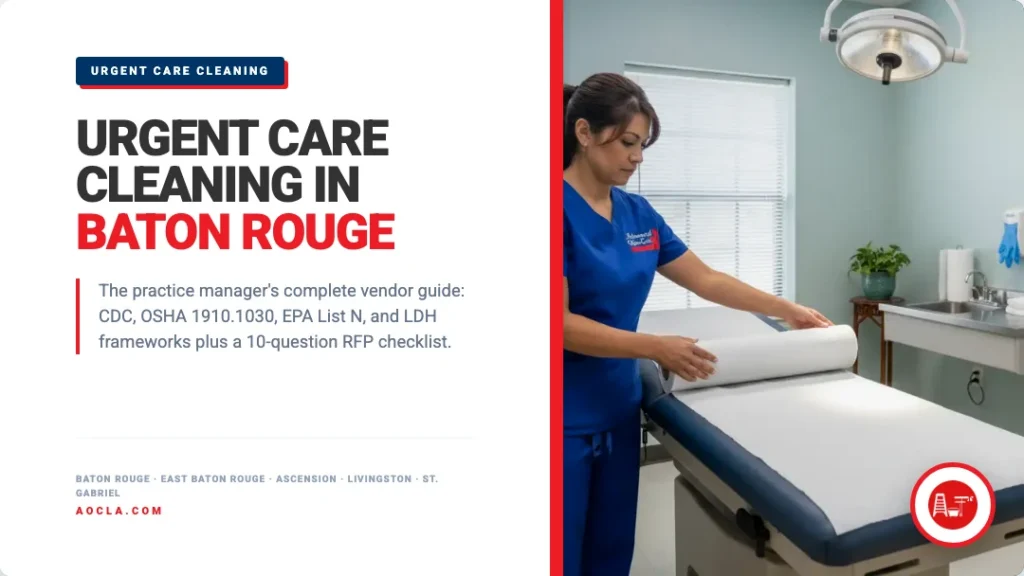
Cleaning an urgent care facility is not cleaning an office with stethoscopes in it. The regulatory layers stack, federal infection-control standards from the Centers for Disease Control and Prevention, OSHA’s bloodborne pathogen standard, EPA-registered disinfectant labeling requirements, and Louisiana Department of Health facility expectations. The clinical equipment is shared between patients. The waste streams are separated. The disinfectant contact times are measured in minutes, not seconds. And the cost of getting it wrong is documented: the Agency for Healthcare Research and Quality estimates healthcare-associated infections drive $28 to $33 billion in excess U.S. healthcare costs annually, and the CDC’s most recent point-prevalence work found roughly 1 in 31 hospitalized patients carries at least one HAI on any given day.
This guide is for the urgent care practice manager, office administrator, or building owner in the Baton Rouge metro and Capital Region who’s vetting a cleaning vendor, whether for a new contract, an underperforming incumbent, or a facility expansion. Advanced Office Care has cleaned Baton Rouge-area commercial and medical facilities since 2006; this is the framework we wish every prospective client used before signing.
Key Takeaways
- Four regulatory frameworks govern urgent care cleaning in Louisiana: CDC environmental cleaning guidance, OSHA’s Bloodborne Pathogen Standard 29 CFR 1910.1030, EPA List N disinfectant registration, and the Louisiana Department of Health Bureau of Sanitarian Services.
- HAI cost math justifies the vendor premium. AHRQ data show per-incident HAI costs ranging from roughly $600 for the lowest-severity events to $70,696 for a central-line bloodstream infection (CLABSI) per the AHRQ hospital-acquired condition cost estimates. One avoided infection pays for years of professional cleaning.
- Contact time is the most-missed compliance issue. EPA-registered disinfectants on List N carry specific wet-contact times (typically 1 to 10 minutes); the surface must remain visibly wet for the full labeled time or disinfection is invalid. Spray-and-wipe immediately is the most common failure in clinical cleaning.
- OSHA 1910.1030 applies to your cleaning vendor’s employees. Per an OSHA Letter of Interpretation (2007), the Bloodborne Pathogen Standard applies to contract cleaning workers regardless of how much time has elapsed since contamination, meaning your vendor needs a written Exposure Control Plan, annual training, HBV vaccine offer, PPE provisioning, and regulated-waste handling protocols.
- Vet vendor accountability before price. A 10-question RFP separates a vendor running OSHA-compliant medical cleaning from a vendor running office cleaning with extra disinfectant. See the checklist below.
Why Urgent Care Cleaning Is Different from Office Cleaning
Most commercial cleaning vendors in the Baton Rouge metro are office-cleaning operations that occasionally take a medical client. The work looks similar from across the parking lot. Inside the building, the differences are real, regulatory, and audit-relevant.
The first difference is shared diagnostic equipment. A blood pressure cuff, stethoscope, and otoscope handle move from patient to patient. They’re not the cleaning crew’s responsibility every shift, but they are the cleaning crew’s responsibility at end-of-day terminal cleaning and after any visible contamination event. Office cleaning doesn’t have noncritical patient-care equipment to track.
The second difference is regulated waste. Sharps containers, biohazard bags, and any blood-or-other-potentially-infectious-materials (OPIM) contaminated waste fall under OSHA 1910.1030(d)(4) and Louisiana’s regulated medical waste rules. Office cleaning crews put trash in dumpsters. Urgent care cleaning crews separate three waste streams.
The third difference is contact time discipline. Office cleaning often uses general-purpose cleaners that work in seconds: wipe, move on. Urgent care cleaning requires EPA-registered disinfectants used per label, including wet-contact times measured in minutes per CDC environmental cleaning procedures. Wiping a surface dry before contact time elapses voids the disinfection.
The fourth difference is documented training. OSHA 1910.1030 requires annual bloodborne pathogen training, with documentation, for any worker reasonably anticipated to encounter blood or OPIM. Office cleaning workers don’t have that requirement.
The Four Regulatory Frameworks Every Baton Rouge UC Manager Must Know
1. CDC Environmental Cleaning Guidance
The CDC’s Environmental Cleaning Procedures for healthcare settings and its outpatient infection prevention expectations define the canonical practices for ambulatory care environments, including urgent care. Key concepts include high-touch surface inventories, zone-based cleaning (patient zone vs. healthcare-worker zone), and the requirement for a documented facility-specific cleaning program with responsible person, frequency, product, and process named for every surface and task.
CDC also publishes a downloadable Best Practices for Environmental Cleaning in Healthcare Facilities document and an Environmental Cleaning Program Improvement Toolkit that gives practice managers the audit instruments to verify a vendor’s work.
2. OSHA Bloodborne Pathogen Standard 29 CFR 1910.1030
OSHA 29 CFR 1910.1030 is the federal standard governing exposure to blood and other potentially infectious materials. It applies to your cleaning vendor’s employees, not just to your clinical staff. The vendor’s compliance obligations include:
- Written Exposure Control Plan updated annually, naming employee job classifications with reasonably anticipated exposure
- HBV (Hepatitis B) vaccine offer to all exposed employees at no cost
- Annual training on bloodborne pathogen risks, exposure procedures, and PPE
- Engineering controls (sharps containers, mechanized handling where applicable)
- Work practice controls (PPE provisioning, no-recapping of needles, regulated waste handling)
- Post-exposure follow-up with medical evaluation and prophylaxis
A practice manager evaluating a vendor should ask to see the Exposure Control Plan and the most recent training documentation. A vendor who can’t produce these is operating outside the standard.
3. EPA List N Registered Disinfectants
The EPA’s List N database catalogs disinfectants registered for use against SARS-CoV-2 and other emerging viral pathogens. Beyond COVID-19, the list functions as the canonical reference for EPA-registered hospital-grade disinfectants, including their label-specified contact times.
Quaternary ammonium (quat) compounds dominate the registered-product list. Accelerated hydrogen peroxide products run second. Hypochlorite (bleach) solutions are required for OSHA-specified bloodborne pathogen spill response per the standard. A practice manager should expect their vendor to use products from List N, name those products in the scope of work, and provide the Safety Data Sheets on request.
The critical compliance issue with EPA-registered disinfectants is wet-contact time. Per CDC environmental cleaning guidance, the surface must remain visibly wet for the full labeled contact time. A 1-minute contact-time product applied with a spray-and-wipe-dry motion in 5 seconds achieves cleaning (debris removal) but not disinfection. This is the single most-missed compliance issue in clinical cleaning audits.
4. Louisiana Department of Health (LDH)
Louisiana’s Bureau of Sanitarian Services under LDH and the Health Standards Section administer the state’s Louisiana Sanitary Code (Title 51) and facility licensing requirements respectively. Standalone urgent care facilities in Louisiana sit in a different licensing posture from acute care hospitals, practice managers should verify current LDH licensure expectations directly with the Health Standards Section before relying on any blanket statement about urgent care licensure status, as state requirements evolve.
What does apply universally in Louisiana: Title 51 sanitary code provisions on regulated medical waste, public-health-related sanitation, and food-service overlay rules when applicable. Any vendor working in a Louisiana medical facility should know Title 51 exists and be able to discuss the regulated-waste portions in operational terms.
High-Touch Surfaces: The Inventory That Drives the Frequency
The single most-important operational document in urgent care cleaning is the high-touch surface inventory. This is the surface-by-surface list that drives both daily frequency and per-patient cleaning between visits.
Per CDC’s environmental cleaning procedures, the high-touch list in a clinical exam room includes the exam table (vinyl covering), door handles (interior and exterior), light switches, faucet handles, soap and sanitizer dispensers, paper towel dispensers, the computer keyboard at the clinical workstation, the patient chair armrests, and the writing-surface counter.
Beyond fixed room surfaces, the noncritical patient-care equipment category, defined by CDC to include blood pressure cuffs, stethoscopes, otoscope handles, ophthalmoscopes, pulse oximeters, thermometers, requires more frequent cleaning than walls and floors. The boundary between “cleaning vendor’s responsibility” and “clinical staff’s responsibility” varies by practice; the contract should name it explicitly.
Daily, Weekly, and Monthly Cleaning Task Matrix
Cleaning frequency in an urgent care doesn’t reduce to a single per-day count. It runs across multiple tiers, per-patient between visits, end-of-day, weekly detail, monthly project, and quarterly through annual.
Per OSHA 1910.1030(d)(4)(ii)(A), contaminated work surfaces must be decontaminated after procedures, immediately upon visible contamination, and at end of work shift at minimum. The vendor’s daily schedule has to satisfy that floor. Beyond the OSHA minimum, CDC’s environmental cleaning guidance and industry-standard practice fill in weekly, monthly, and quarterly tiers.
Contact Time, Dwell Time, and Why “Spray and Wipe” Fails Inspections
Disinfection requires the disinfectant chemical to remain in contact with the surface for the full label-specified time, and the surface must remain visibly wet during that period. The CDC environmental cleaning guidance is explicit on this point. So is every EPA-registered disinfectant label.
Practical contact-time ranges from EPA List N: – Hydrogen peroxide accelerated wipes: typically 1 to 3 minutes – Quaternary ammonium (quat) wipes: typically 1 to 5 minutes, with some up to 10 minutes for specific organism claims – Alcohol-based wipes (70% IPA): typically 30 to 60 seconds for non-spore-forming organisms – Hypochlorite (1:10 bleach) for blood/OPIM spills: 10 minutes per OSHA bloodborne pathogen interpretation
The most common audit failure: a cleaning worker sprays a surface, immediately wipes it dry, and moves on. The label time was 3 minutes; actual contact was 5 seconds. The surface is cleaned but not disinfected. Repeated across an exam room, that’s a documented protocol violation.
A vendor running a real clinical cleaning operation will train workers on the wet-and-walk-away discipline: apply, observe wet, move to the next surface or task, return to confirm wet contact at the label time. The wet wipe stays in service across multiple surfaces if and only if the product label permits it.
Bloodborne Pathogen Response: What Your Cleaning Vendor Must Document
OSHA 29 CFR 1910.1030 requires the cleaning vendor to maintain documented evidence of bloodborne pathogen compliance. Practice managers evaluating a vendor should specifically request:
- The current Exposure Control Plan: must be updated annually per 1910.1030(c)(1)(iv) and must reflect changes in technology that reduce or eliminate exposure
- Job classifications with reasonably anticipated exposure: cleaning workers in clinical settings should be named
- Records of HBV vaccine offer to each named-classification employee (and signed declination forms for any worker who refused)
- Annual training documentation with dates, content covered, names of trainees, and trainer qualifications
- PPE provisioning records: gloves, eye protection, masks supplied at no cost to employees per the standard
- Post-exposure procedure documentation: what happens if a worker is exposed during cleaning operations
- Sharps disposal and regulated-waste handling procedures: including chain of custody for regulated waste pickup
The first vendor question to ask: “Can I see your Exposure Control Plan?” A vendor running OSHA-compliant medical cleaning will produce it within the day. A vendor who can’t is operating outside the standard.
How to Vet a Baton Rouge Urgent Care Cleaning Vendor: 10-Question RFP Checklist
The contract structure that surfaces vendor capability is a written RFP with the following 10 questions. Most generalist commercial cleaning vendors won’t answer all of them. That’s the signal.
- Show me your current OSHA 1910.1030 Exposure Control Plan. (Required documentation; should be produced within 24-48 hours of the request.)
- Which EPA List N disinfectant products will your crew use in our facility, and what are the wet-contact times on the labels? (Should name specific products with their EPA registration numbers.)
- How will your crew apply disinfectant to ensure full wet-contact time? (Look for “apply, move on, return to confirm” or equivalent discipline.)
- What’s your training cycle for bloodborne pathogen compliance, and can I see training records? (Annual minimum per OSHA.)
- How do you handle a blood or OPIM spill during routine cleaning? (Should reference 1:10 hypochlorite, 10-minute contact time, PPE, regulated waste disposal.)
- What’s the boundary between your responsibility and our clinical staff’s responsibility for noncritical patient-care equipment (BP cuffs, stethoscopes, otoscope handles)? (Should be written into the SOW.)
- How do you separate regulated medical waste from regular trash in our facility, and what’s your chain of custody for pickup?
- What’s your contingency plan if your assigned crew is unavailable on a clinical workday? (Critical for high-volume urgent care, coverage gaps are real risk.)
- What documentation will you provide to support our accreditation or compliance audits? (CDC environmental cleaning toolkit checklists, training records, MSDS files, etc.)
- References from at least 2 other Baton Rouge metro medical facilities (urgent care, specialty clinic, dental, or surgical) that we can call. (Vertical reference, not just a generic commercial reference.)
The right vendor answers all 10 in a single 30-minute conversation. The wrong vendor evades or defers. That’s the actual evaluation criterion.
What This Costs, and What One HAI Costs You Instead
Healthcare cleaning carries a vendor premium over standard commercial cleaning, typically 25 to 50 percent above generic office cleaning rates per industry composite reporting. The premium reflects the compliance overhead: training, documented Exposure Control Plans, EPA List N products instead of general-purpose cleaners, PPE provisioning, and the cost of operating at the contact-time discipline that CDC and EPA require.
On the other side of the cost math, AHRQ’s hospital-acquired condition cost estimates put per-incident healthcare-associated infection costs at:
- Surgical site infection (SSI): approximately $5,985 per incident
- Catheter-associated urinary tract infection (CAUTI): approximately $31,253 per incident
- Central-line associated bloodstream infection (CLABSI): approximately $43,975 to $70,696 per incident
Urgent care doesn’t carry the same per-incident risk profile as ICU-level acute care, the highest-cost HAIs (CLABSI, CAUTI) are device-associated, and urgent care performs fewer invasive procedures. But the per-incident framing still anchors the cost-benefit math. One avoided infection at the lowest-cost end of the AHRQ scale ($600 for the simplest hospital-acquired condition) covers months of professional cleaning. One CAUTI prevented covers years of vendor spend.
The right framing for a practice manager pitching the cleaning line item to a partner or board: cleaning is the cheapest infection prevention investment a clinical facility makes, and the documented per-incident HAI costs from AHRQ are the comparison benchmark.
Common Questions About Urgent Care Cleaning in Baton Rouge
These are the questions Baton Rouge metro urgent care practice managers ask in the first vendor conversation. Most have clear regulatory answers; a couple depend on facility-specific context that the vendor should be able to discuss.
What’s the difference between cleaning and disinfecting in an urgent care?
Cleaning is the physical removal of soil, dust, and organic debris from a surface. Disinfection is the chemical reduction of pathogenic organisms on a surface to safe levels, measured in log-reduction against label-specified organisms. Per CDC environmental cleaning guidance, cleaning must precede disinfection (organic debris on a surface neutralizes most disinfectants). The two are distinct operational steps, not synonyms.
How often should a Baton Rouge urgent care be cleaned?
The OSHA minimum, per 29 CFR 1910.1030(d)(4)(ii)(A), is decontamination after procedures, immediately upon visible blood/OPIM contamination, and at end of work shift. The CDC environmental cleaning guidance layers on per-patient cleaning of high-touch surfaces in clinical zones, daily end-of-day cleaning of the whole facility, weekly detail work, and monthly through annual project work. The companion guide Cleaning Frequency Guide: Daily / Weekly / Monthly Tasks for an Urgent Care Facility covers the full matrix.
Are urgent care facilities licensed by Louisiana?
Louisiana’s healthcare facility licensing framework is administered by the LDH Health Standards Section. Standalone urgent care facilities sit in a different licensure posture from acute care hospitals, and the specific licensure expectations evolve. Verify current licensure status for your specific facility type directly with LDH Health Standards before relying on any blanket statement. What does apply broadly: Louisiana Title 51 sanitary code provisions on regulated medical waste, sanitary practices, and food-service overlays where applicable.
Does my cleaning vendor need OSHA training?
Yes. Per OSHA 29 CFR 1910.1030, the Bloodborne Pathogen Standard applies to cleaning workers who have reasonably anticipated exposure to blood or OPIM. An OSHA Letter of Interpretation from 2007 is explicit that this applies to contract cleaning company employees regardless of how much time has elapsed since the contamination event. Your vendor needs a written Exposure Control Plan, annual training, HBV vaccine offer, PPE provisioning, and regulated-waste handling, full stop.
What’s “EPA List N” and why does it matter?
EPA List N is the federal list of disinfectant products registered for use against SARS-CoV-2 and other emerging pathogens. It’s the canonical reference for hospital-grade disinfectants and their EPA-registered contact times. A vendor working in your urgent care should use List N products, name them in the scope of work, and provide Safety Data Sheets. Wet-contact time discipline (keeping the surface visibly wet for the full label time) is the single most-missed compliance issue.
Can we use the same cleaning vendor for our urgent care and for our office locations?
Operationally, yes. Many commercial vendors handle mixed portfolios. The vendor question that matters: do they staff the urgent care contract with workers trained for the urgent care, or rotate generic office-cleaning workers through the clinical space? A real medical-cleaning operation will have a dedicated medical cleaning team with documented bloodborne pathogen training; office workers will not be reassigned to clinical work without that training and documentation. Ask the vendor specifically.
How do I evaluate whether our current cleaning vendor is doing the right work?
The CDC publishes an Environmental Cleaning Program Improvement Toolkit with audit checklists practice managers can use without disrupting daily operations. Spot-checks for visible cleanliness, contact-time observation during a cleaning visit, and document review (Exposure Control Plan, training records, MSDS files) are the practical evaluation tools. Our companion piece 5 Signs Your Urgent Care Facility Needs a Specialized Cleaning Service covers the practice-manager-side red flags.
Cleaning services for medical and specialty practices in the Baton Rouge metro:
Need a Baton Rouge urgent care cleaning vendor that runs the full regulatory framework?
Advanced Office Care has cleaned Baton Rouge-area commercial and medical facilities since 2006. We’re family-owned by Clay and Nessa Vavasseur, locally based, and we run the OSHA 1910.1030 / CDC / EPA / LDH framework documented in this guide. Same Capital Region service area: Baton Rouge, East Baton Rouge Parish, Ascension Parish, Livingston Parish, West Baton Rouge, Iberville, and St. Tammany.
About Advanced Office Care
Advanced Office Care LLC is a Baton Rouge-area commercial cleaning company founded in 2006 by Clay and Nessa Vavasseur. We specialize in medical and urgent care cleaning, electrostatic disinfection, office cleaning, and floor maintenance across the Baton Rouge metro and Capital Region, including East Baton Rouge, Ascension, Livingston, West Baton Rouge, Iberville, and St. Tammany Parishes. Learn more at aocla.com or visit our contact page.