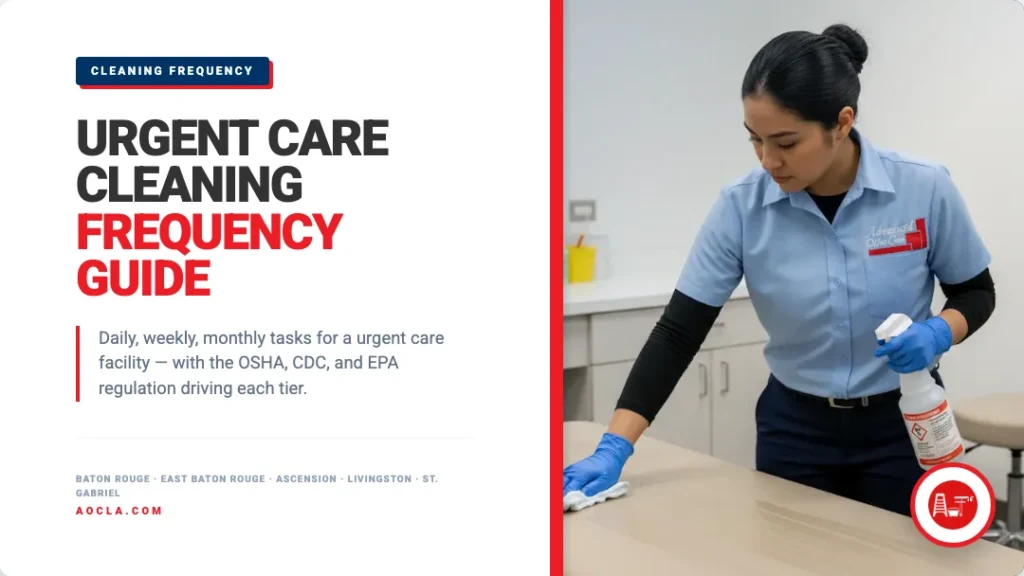
The federal regulators set the floor and stop. OSHA 29 CFR 1910.1030(d)(4)(ii)(A) requires contaminated work surfaces to be decontaminated “after procedures, immediately upon visible contamination, and at end of work shift” at minimum. CDC environmental cleaning guidance layers on high-touch surface attention, zone-based cleaning, and the requirement that every facility document responsible person, frequency, product, and process for every cleaning task. Beyond those two anchors, the operating standard for urgent care cleaning frequency comes from industry standard practice, UCA accreditation expectations, AAAHC standards, IICRC for floor care specifically, plus the practice manager’s job to build a facility-specific schedule the CDC explicitly says is the facility’s responsibility.
This guide is the full matrix. Per-patient between visits, daily at end of shift, weekly detail, monthly project, quarterly through annual. Each tier names the regulatory driver where one applies and the industry standard where one doesn’t.
Key Takeaways
- The OSHA floor: per 29 CFR 1910.1030(d)(4)(ii)(A), contaminated work surfaces must be decontaminated after procedures, immediately upon visible contamination, and at end of work shift. That’s the federal minimum.
- The CDC layer: per CDC environmental cleaning procedures, high-touch surfaces in patient-care zones require more frequent cleaning than walls and floors. Noncritical patient-care equipment (BP cuffs, stethoscopes, otoscope handles) needs between-patient attention.
- The contact-time discipline: EPA-registered disinfectants on List N carry label contact times typically between 1 and 10 minutes. The surface must remain visibly wet for the full label time, or disinfection is invalid.
- The Louisiana layer: Louisiana Department of Health Bureau of Sanitarian Services administers Title 51 Sanitary Code provisions on regulated medical waste, sanitary practices, and food-service overlays where applicable.
- The annual OSHA review: per 1910.1030(c)(1)(iv), the Exposure Control Plan must be updated annually, that’s the once-a-year compliance review that goes alongside the deep cleaning calendar.
Per-Patient (Between Visits)
The per-patient tier is driven by OSHA 1910.1030(d)(4)(ii)(A) (decontamination after procedures), CDC noncritical patient-care equipment guidance (BP cuffs, stethoscopes, etc. need between-patient attention), and practical infection-control concern (surface contamination data on patient-contact items runs high, see our high-touch surfaces walkthrough).
Standard per-patient task list for an urgent care exam room:
- Replace exam table paper roll, single-use barrier per CDC; no reuse
- Disinfect exam table vinyl with quaternary ammonium or accelerated hydrogen peroxide wipe; observe label contact time (typically 1 to 3 minutes wet)
- Disinfect blood pressure cuff with 70% isopropyl alcohol or quat wipe; observe contact time. Peer-reviewed data show BP cuffs contaminated in up to 100% of inner-surface samples in some emergency department studies, this is not a low-priority task.
- Disinfect stethoscope chest piece and earpieces with alcohol wipe. The Nature Scientific Reports 2025 systematic review found mean stethoscope contamination at 85% across 28 studies, disinfect between every patient.
- Discard otoscope tip (single-use); wipe otoscope handle with alcohol
- Disinfect patient chair armrests with quat or hydrogen peroxide wipe
- Disinfect door handles (interior + exterior of exam room) per CDC high-touch surface guidance
- Disinfect light switch if touched during the visit
- Disinfect writing surface or counter if used during the visit
Estimated time: 3 to 5 minutes per exam room turnover, assuming contact-time discipline is observed (the surfaces remain visibly wet for the full label time before the next patient enters).
Daily (End of Business Day)
The daily tier is driven by OSHA 1910.1030(d)(4)(ii)(A) (end-of-shift decontamination) and CDC environmental cleaning procedures for high-touch surface frequency in clinical areas.
Standard daily end-of-business-day task list:
- Damp-mop all floors in clinical areas with neutral cleaner first, then disinfect; non-clinical areas with neutral cleaner only
- Vacuum carpeted areas (lobby, business office, breakroom if carpeted)
- Empty all trash, regular municipal solid waste separated from regulated medical waste (red bag) per OSHA and Louisiana Title 51
- Full restroom disinfection including all fixtures, mirrors, dispensers, and floor
- Disinfect reception desk including pen cup, sign-in tablets/iPads (clinical waiting-room touchpoints), and phone handsets
- Disinfect waiting room, chair arms, magazine tables, water cooler, coffee station, children’s play area if applicable
- Disinfect clinical workstation keyboards (wipeable barrier covers strongly recommended; if exposed keyboards, allow contact time)
- Disinfect break room including refrigerator handle, microwave, coffee maker
- Wipe and disinfect computer mice at all clinical workstations
- Wipe all door handles and light switches facility-wide
- Check sharps containers; replace any at or above 3/4 fill line
- Verify regulated waste pickup is scheduled or stage red bags per chain-of-custody protocol
Estimated time: 60 to 120 minutes for a single-provider urgent care; 2 to 4 hours for a multi-provider/multi-exam-room facility.
Weekly
Weekly tasks are industry standard rather than regulatory mandate. CDC’s Environmental Cleaning Program Improvement Toolkit recommends documented schedules; the specific tasks below reflect ambulatory care industry practice.
- Detail dusting of horizontal surfaces above eye level (top of cabinets, supply shelves, electronics, blinds, vents), top-down sequence
- Glass and mirror cleaning, lobby windows, glass entry doors, exam room mirrors
- Floor scrubbing beyond daily damp mop, addresses scuff marks and embedded soil
- Refrigerator interior cleaning, both clinical specimen storage (per facility protocol) and break room
- HVAC return vent face cleaning, accessible vents in clinical and non-clinical areas
- Baseboards, wipe down accumulated dust and scuff marks
- Supply closet, wipe shelving, verify regulated-waste storage chain of custody
- Inventory cleaning consumables, gloves, paper towels, soap, sanitizer, disinfectant wipes; replenish before depletion
Estimated time: 60 to 90 additional minutes one day per week beyond daily tasks.
Monthly
- High dusting, ceiling vents, light fixtures, top of door frames, exit signs
- Floor buffing or burnishing for resilient hard floors (LVT, VCT), surface conditioning beyond daily clean
- Carpet extraction in carpeted areas (lobby, business office)
- Upholstery deep clean for fabric chairs and waiting room seating
- Window blinds or curtains detail cleaning
- HVAC filter inspection (and replacement on the facility’s filter schedule)
- Storage rooms and back-of-house, full detail cleaning including shelf wipe-down
Estimated time: 2 to 4 hours per month beyond daily and weekly tasks.
Quarterly
- Strip-and-wax for VCT or other refinishable resilient floors (if applicable to facility floor type)
- HVAC duct inspection, visible inspection of accessible returns
- Furniture deep sanitize, full disinfection of exam room and waiting room furniture
- Outdoor entry and walkway pressure-wash (if applicable; weather-dependent in Louisiana)
Estimated time: 1 full day per quarter for the deep-clean tasks; can be scheduled on a weekend or non-clinical day.
Annual
- Floor refinish, full strip, seal, and refinish cycle for resilient floors (VCT, LVT, polished concrete)
- Indoor air quality (IAQ) inspection, typically conducted by a separate HVAC or IAQ vendor
- OSHA Exposure Control Plan annual review, required by 29 CFR 1910.1030(c)(1)(iv); not a cleaning task per se, but the cleaning vendor’s compliance documentation needs annual update
- Cleaning vendor contract review, frequency calibration to actual facility patient volume, scope adjustments, pricing review
Estimated time: 1 to 3 days per year depending on facility size and floor type.
Patient Volume Scaling
Cleaning frequency at the per-patient and daily tiers scales with patient volume. The categorization that matters operationally:
- Low-volume urgent care (<50 patient visits/day): Baseline schedule above works. Single end-of-day cleaning cycle, per-patient between-visit cleaning handled by clinical staff or by a daytime light-touch from the vendor.
- Mid-volume urgent care (50 to 100 visits/day): Add a midday touchpoint pass on lobby high-touch surfaces, restrooms, and reception area. Often handled by the vendor as a 20- to 30-minute “midday refresh” between operating hours peaks.
- High-volume urgent care (100+ visits/day): Dedicate a daytime porter or assign a clinical-cleaning team member to handle continuous lobby + restroom + waiting room maintenance during operating hours, plus the full end-of-day cycle.
The volume scaling shows up in vendor pricing, high-volume facilities pay roughly 20 to 40% more per square foot per month than low-volume facilities for the same physical footprint, reflecting the daytime porter assignment.
What This Schedule Costs (Industry Benchmarks)
Healthcare cleaning carries a vendor premium over generic office cleaning. Industry composite reporting puts the premium at roughly 25 to 50% above standard commercial rates, reflecting the compliance overhead: OSHA-compliant training programs, EPA List N product procurement, dedicated medical-cleaning crews, documented Exposure Control Plans, PPE provisioning, and the wet-contact-time discipline that takes longer than spray-and-wipe.
Specific monthly per-square-foot ranges vary widely by region, patient volume, and contract structure. The right benchmark for a Baton Rouge metro urgent care manager is two competitive bids from vendors that can produce their OSHA 1910.1030 Exposure Control Plan on request, see the vendor vetting framework in the practice manager’s complete guide.
The cost-benefit framing that matters: per AHRQ’s hospital-acquired condition cost estimates, per-incident healthcare-associated infection costs range from roughly $600 for the lowest-severity events to $70,696 for a central-line bloodstream infection. One avoided infection at the lowest end covers months of professional cleaning; one CAUTI prevented covers years.
Common Questions About Urgent Care Cleaning Frequency
These are the questions Baton Rouge metro urgent care practice managers ask when calibrating their cleaning schedule or evaluating vendor compliance with the OSHA + CDC frequency floor.
Does OSHA require my urgent care to be cleaned daily?
OSHA 29 CFR 1910.1030(d)(4)(ii)(A) requires contaminated work surfaces to be decontaminated at minimum after procedures, immediately upon visible blood/OPIM contamination, and at end of work shift. End of work shift means end of business day for most urgent cares. That’s the federal floor. The CDC environmental cleaning guidance layers on additional high-touch surface attention through the day, and patient-care equipment requires between-patient cleaning per CDC’s noncritical equipment guidance.
How long should our cleaning vendor spend per night in an urgent care?
For a single-provider urgent care with one or two exam rooms, expect 60 to 120 minutes per cleaning visit. For a multi-provider, multi-exam-room facility, 2 to 4 hours. Specific time depends on facility size, patient volume, and the SOW. A vendor quoting 30 minutes per night for an urgent care is not running the OSHA + CDC framework, they’re running residential or light-commercial cleaning at a healthcare price point.
Are blood pressure cuffs and stethoscopes my cleaning vendor’s responsibility?
The boundary varies by contract. The CDC noncritical patient-care equipment guidance requires these to be cleaned between patients, but the operational responsibility is typically split between clinical staff (between-patient cleaning by the medical assistant or provider) and the cleaning vendor (end-of-day terminal cleaning of all noncritical equipment). The contract should name the boundary explicitly. Peer-reviewed data show stethoscopes contaminated in 85% of cultures and BP cuffs colonized in up to 100% of inner-surface samples, this is not a tier that can be skipped.
What happens if our vendor skips contact-time discipline?
Surfaces are cleaned but not disinfected. Per CDC environmental cleaning guidance, EPA-registered disinfectants must remain visibly wet on the surface for the full label contact time, typically 1 to 10 minutes depending on the product. Spray-and-wipe immediately fails. In a regulatory audit (OSHA inspection, AAAHC or UCA accreditation site visit), documented contact-time non-compliance is an audit finding. In the day-to-day, the surface contamination rates measured in peer-reviewed studies don’t drop; HAI risk doesn’t drop.
How does our cleaning frequency change during flu season or a local COVID surge?
The OSHA floor doesn’t change, decontamination after procedures and at end of shift is constant. What changes operationally: the mid-day touchpoint pass becomes more important (waiting room high-touch surfaces, restroom touchpoints), restroom disinfection may shift from daily to twice-daily, and electrostatic disinfection becomes a higher-value add-on for whole-room coverage between high-volume shifts. Our companion piece on electrostatic disinfection covers when surge-period application is worth the line item.
Does Louisiana have specific frequency requirements beyond the OSHA + CDC framework?
Louisiana Department of Health Bureau of Sanitarian Services administers the state’s Title 51 Sanitary Code, which covers regulated medical waste, sanitary practices, and food-service overlays. Specific frequency intervals beyond the OSHA + CDC framework are not broadly published as state-level mandates for urgent care facilities. For licensure-specific questions, verify directly with LDH Health Standards Section for your specific facility type.
What’s the most common mistake practice managers make on cleaning frequency?
Underspecifying the per-patient between-visit tier in the contract. The end-of-day deep clean is visible and easy to specify. The between-patient cleaning of exam tables, BP cuffs, stethoscopes, and door handles is operationally invisible to a practice manager who’s at the front desk or in their office, and it’s the highest-stakes tier from an HAI prevention standpoint. The contract should name explicitly who handles each between-patient task (vendor daytime porter, clinical staff, both with a documented hand-off).
Need a Baton Rouge urgent care cleaning vendor that runs the full frequency framework above?
Advanced Office Care has cleaned Baton Rouge-area medical facilities since 2006. We’re family-owned by Clay and Nessa Vavasseur and we run the OSHA 1910.1030 + CDC + EPA framework with the contact-time discipline that compliance and patient safety both require. Same Capital Region service area: Baton Rouge, East Baton Rouge, Ascension, Livingston, West Baton Rouge, Iberville, and St. Tammany Parishes.
Request a Cleaning Quote from Advanced Office Care
About Advanced Office Care
Advanced Office Care LLC is a Baton Rouge-area commercial cleaning company founded in 2006 by Clay and Nessa Vavasseur. We specialize in medical and urgent care cleaning, electrostatic disinfection, office cleaning, and floor maintenance across the Baton Rouge metro and Capital Region. Learn more at aocla.com or visit our contact page.