Urgent Care Cleaning in Baton Rouge: Vendor or In-House Staff?
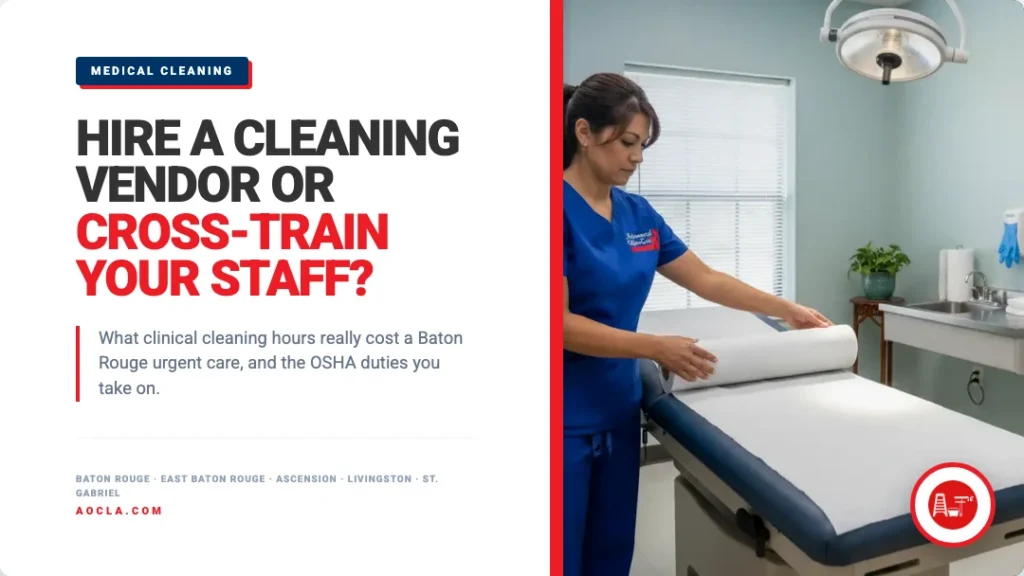
Cross-train your own staff only for between-patient turnover, and bring in a vendor for terminal cleaning, floors, and anything involving blood or body fluids. The reason is not effort. It is that clinical hours cost more than cleaning hours, and the moment your employees have occupational exposure you inherit the full OSHA bloodborne pathogens standard.
TLDR:
- In the Baton Rouge metro, medical assistants average $17.86 an hour against $14.89 for cleaners, so clinical cleaning hours cost more.
- The hourly gap is the small cost. Lost patient throughput during peak hours is the large one.
- Once your own staff have occupational exposure, OSHA’s bloodborne pathogens standard applies to you directly.
- That means a written exposure control plan reviewed at least annually, free hepatitis B vaccination, annual paid training, PPE at no cost, and a sharps injury log.
- A hybrid split is what most urgent cares land on, and it is usually the right answer.
- Three specific situations make full in-house cleaning genuinely defensible.
- Run the decision on total cost and regulatory exposure, not on the hourly rate alone.
Baton Rouge urgent cares run on throughput. A clinic off Airline Highway or Bluebonnet that sees 40 patients on a Monday cannot afford a room sitting dirty for eleven minutes while the only medical assistant on the floor finishes wiping it down. That tension, staffing against volume, is what pushes practice managers to ask one question: should cleaning be a job they hire for, or a task they train for?
Not sure where the line should sit in your clinic? We will walk your space, look at your patient volume and room count, and tell you honestly which tasks are worth keeping in-house and which are not.
What Cross-Training Actually Costs Per Hour
Start with the number most practices skip. The question is not what a cleaner costs, it is what your clinical hour costs when you spend it on cleaning.
Federal wage data for the Baton Rouge metro area puts medical assistants at a mean of $17.86 an hour. Janitors and cleaners come in at a mean of $14.89 an hour, per the Bureau of Labor Statistics Occupational Employment and Wage Statistics for Baton Rouge. Annualized, that is $37,140 against $30,960.
That roughly 20 percent gap is real, but it is the smaller half of the story. The larger half is what the clinical hour was going to produce instead. An hour your medical assistant spends stripping a room is an hour not spent rooming patients, running point-of-care tests, or closing charts. In a clinic with two MAs and a full waiting room, that hour has a throughput cost your payroll report will never show you.
Benefits and payroll burden widen the gap further, since a clinical employee’s loaded cost runs well above base wage. If you want the underlying task-by-task picture before you price anything, our daily, weekly, and monthly cleaning schedule for an urgent care lays out what actually has to happen and how often.
The Regulatory Cost Nobody Prices In
This is the part that changes the decision, and it has nothing to do with wages. It has to do with who legally owns the exposure.
When your own employees have occupational exposure to blood or other potentially infectious materials, OSHA’s bloodborne pathogens standard, 29 CFR 1910.1030, applies to you as the employer. Cross-training an MA to handle a blood spill does not just add a task to their job description. It pulls a whole compliance program onto your practice.
Here is what the standard actually obligates an employer to do.
| Requirement | What OSHA 1910.1030 says |
|---|---|
| Exposure control plan | Written, and “reviewed and updated at least annually and whenever necessary to reflect new or modified tasks and procedures” |
| Hepatitis B vaccination | “Made available at no cost to the employee,” and offered “within 10 working days of initial assignment” |
| Training | At initial assignment and “at least annually thereafter,” provided “at no cost to the employee and during working hours” |
| Personal protective equipment | “Provided, at no cost to the employee, appropriate personal protective equipment” |
| Sharps injury log | Employers must “establish and maintain a sharps injury log for the recording of percutaneous injuries from contaminated sharps” |
Read that table as a recurring operating cost, not a one-time setup. Annual training is paid time off the floor for every covered employee, every year. The vaccination offer follows every new hire within ten working days. The plan has to be revisited annually and rewritten whenever you change a procedure.
A cleaning vendor that specializes in medical facilities already runs this program for its own crew. That does not erase your own obligations toward your clinical staff, who still have exposure through patient care. It does mean you are not extending the program to cover a second category of work you chose to bring in-house.
Where the Line Usually Falls
Most urgent cares that think this through do not land on all-vendor or all-staff. They split the work by who is already standing there.
Keep in-house: between-patient turnover. Your MA is already in the room, already gloved, and the room needs to flip in minutes. Handing that to a vendor is slower and more expensive. This is genuinely clinical workflow, not janitorial work, and our exam room cleaning workflow covers the sequence that keeps turnover consistent.
Send to a vendor: terminal cleaning, floors, restrooms, and waiting areas. End-of-day work happens after your clinical staff should have gone home. Floor care needs equipment you do not own. Restrooms and lobbies decline on a schedule that has nothing to do with patient volume.
Send to a vendor: anything involving blood or body fluids beyond immediate spot response. This is where the regulatory calculus bites hardest.
The surfaces that matter most in that split are not evenly risky. Our breakdown of high-touch surfaces in an urgent care exam room sorts them into risk tiers, which is a useful way to decide what your own staff should own.
Want the split priced out before you commit? We will scope what a vendor should cover in your clinic and what your team keeps so you can compare it against your current staffing honestly.
When Keeping It In-House Genuinely Makes Sense
The honest answer is that in-house is sometimes right, and a cleaning company telling you otherwise is selling rather than advising. Three situations hold up.
You already employ dedicated non-clinical cleaning staff. If someone on payroll cleans as their actual job rather than as an add-on to clinical duties, you are already paying cleaning wages for cleaning work. The wage argument disappears. You still owe the full OSHA program, but you owed it anyway.
Your volume is genuinely low. A small clinic seeing a handful of patients a day may not generate enough terminal cleaning to justify a service agreement. Watch this one though, because volume grows before anyone updates the process.
You have unusual access or security constraints. Some practices cannot admit outside staff after hours without escort, and the escort cost erases the savings.
Outside those three, the split above tends to win. If you are weighing vendors, the 10-question vetting checklist in our practice manager’s guide is the next thing to read.
How to Run the Decision in Your Own Clinic
Do this on paper before you change anything. It takes about an hour, and it beats arguing from instinct.
Count the cleaning hours your clinic actually needs in a week, separated into between-patient turnover and everything else. Price the second bucket at your loaded clinical wage, not base wage, because that is who would be doing it. Add the recurring compliance line items from the table above: annual paid training hours, the vaccination offer, PPE, and the administrative time to maintain the plan and the log.
Then get a vendor scope priced against that same second bucket and compare the two totals. If the numbers land close, decide on throughput instead, because the clinic that flips rooms faster sees more patients.
One caution on the compliance side: if you are already treating your exposure control plan as a binder nobody opens, adding cleaning duties to clinical job descriptions increases what that binder is supposed to cover. Fix the program first, then decide who cleans.
Questions Baton Rouge Practice Managers Ask About This Decision
These come up on nearly every walkthrough we do at an urgent care. Short answers here, and we will go through your specific rooms and volume in person.
Is it cheaper to have my medical assistants clean instead of hiring a vendor?
Usually not. Baton Rouge medical assistants average $17.86 an hour against $14.89 for cleaners, so you pay more per hour and lose patient throughput at the same time. The savings only appear if your clinic’s volume is low enough that the cleaning hours would otherwise be idle time.
Does OSHA’s bloodborne pathogens standard apply to my clinic if staff clean?
Yes, wherever employees have reasonably anticipated occupational exposure to blood or other potentially infectious materials. Assigning cleaning duties that involve blood or body fluids brings those employees under the standard, which means the exposure control plan, vaccination offer, annual training, PPE, and sharps log requirements apply.
What should my staff keep doing themselves?
Between-patient room turnover. Your medical assistant is already in the room and the room has to flip in minutes, so a vendor adds delay and cost. Terminal cleaning, floor care, restrooms, and waiting areas are the work worth handing off.
How often does bloodborne pathogens training have to happen?
At initial assignment to tasks with occupational exposure, and at least annually after that. OSHA requires it be provided at no cost to the employee and during working hours, so budget it as paid time off the floor every year, not as a one-time onboarding item.
Will a cleaning vendor handle blood spills and biohazard cleanup?
It depends on the vendor and the scope you agree to, so ask directly and get it in the contract. A vendor that serves medical facilities should be able to show you its own exposure control plan and training records for the crew assigned to your building.
Can I start with a vendor for after-hours work only?
Yes, and that is where most urgent cares begin. Terminal cleaning, floors, restrooms, and lobbies move to the vendor while your clinical team keeps between-patient turnover. It is the easiest split to scope and the easiest to expand later.
Ready to see what the split would cost in your clinic? We clean urgent care and specialty medical facilities across Baton Rouge, and we will scope the work honestly, including telling you what your own team should keep.