The peer-reviewed contamination data is unambiguous. A 2025 Nature Scientific Reports systematic review of stethoscope hygiene pooled 28 studies and found mean stethoscope contamination at 85% (range 47 to 100%), and an earlier PubMed analysis showed only 21% of providers cleaned stethoscopes daily and 0% cleaned between patients. Blood pressure cuffs colonized up to 100% of inner-surface samples in some emergency department cohorts, with MRSA recovered from 17 to 31% of swabbed cuffs in a separate hospital study. Otoscope heads showed pathogenic contamination above 40% in a 2013 European Archives of Otorhinolaryngology paper. Pulse oximeter probes ran at 68% contamination pre-decontamination in a 2023 ICU surveillance study.
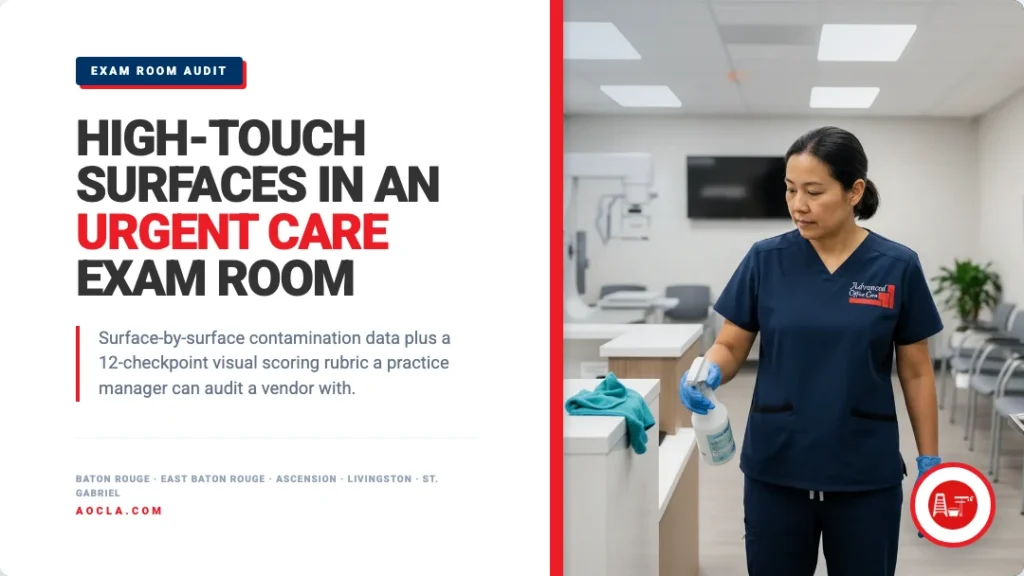
None of these are theoretical risks. They’re documented baselines that drop only when surfaces are actually disinfected, wet contact with an EPA-registered product for the full label time. This guide walks an urgent care exam room surface by surface, names the contamination prevalence, the recommended cleaning frequency, and the disinfectant class with label-typical contact time. It closes with a 12-checkpoint visual scoring rubric an urgent care practice manager can use to audit a cleaning vendor without disrupting patient flow.
Key Takeaways
- Stethoscopes contaminate at 85% mean across the peer-reviewed literature per the Nature 2025 systematic review, and the surface contamination drops to zero recoverable pathogens after a 70% isopropyl alcohol wipe with proper contact time. Disinfection works; the failure is operational, not chemical.
- Blood pressure cuffs are among the highest-risk shared diagnostic surfaces. PMC3824197 documents MRSA on 17 to 31% of cuffs; PubMed 23759042 documents inner-surface colonization near 100% in some emergency department samples.
- High-touch room surfaces (door handles, light switches, faucet handles, dispenser pumps) are explicitly classified by CDC environmental cleaning procedures as requiring more frequent attention than walls and floors.
- The contact-time discipline is the most-missed audit point. Per CDC environmental cleaning guidance, the surface must remain visibly wet for the full EPA label time, typically 1 to 10 minutes depending on the disinfectant. Spray-and-wipe immediately cleans the surface but does not disinfect.
- The OSHA bloodborne pathogen standard applies to cleaning workers. 29 CFR 1910.1030 requires written Exposure Control Plans, annual training, PPE provisioning, and regulated-waste handling for any worker with reasonably anticipated exposure to blood or OPIM, including the cleaning vendor’s staff.
The Four Tiers of Surface Risk in an Exam Room
The CDC environmental cleaning framework organizes clinical surfaces into risk tiers based on patient contact and contamination prevalence. Practical operational tiers for an urgent care exam room:
Tier 1, Direct patient-contact surfaces. Exam table vinyl, exam table paper (single-use), pillowcase if used, patient gown holder. These surfaces touch the patient directly during every visit and require between-patient disinfection.
Tier 2, Shared diagnostic equipment. Blood pressure cuffs, stethoscope chest piece and earpieces, otoscope handle and tip, ophthalmoscope head, pulse oximeter probe, thermometer probe, reflex hammer, tuning fork. This is the highest-contamination tier in peer-reviewed studies, and the most-overlooked tier in many cleaning contracts.
Tier 3, High-touch room surfaces. Door handles (interior + exterior), light switches, faucet handles, soap dispensers, sanitizer dispensers, tissue dispensers, paper towel dispensers, computer keyboard and mouse at the clinical workstation, provider chair armrest, patient chair armrest, writing-surface counter.
Tier 4, Lower-touch surfaces. Floors below the 3-foot zone-cleaning concept boundary, walls in non-patient-contact zones, window sills, HVAC return vents, ceiling tiles. These get attention on the weekly through monthly cycle, not the per-patient cycle.
Surface-by-Surface Table
The matrix below names each clinical exam room surface, the peer-reviewed or CDC-cited contamination prevalence, recommended cleaning frequency, disinfectant class, and label-typical contact time. Sources are linked inline.
The single most-cited finding in this table is also the most operationally important: after a 70% ethanol wipe with proper contact time, no MRSA was recovered from BP cuffs in the follow-up cultures. The disinfection chemistry works. The failure is always procedural, either the cleaning step was skipped, or the wet-contact time was insufficient.
The Contact-Time Variable That Most Audits Miss
The single most common compliance failure in clinical cleaning is improper wet-contact time. EPA-registered disinfectants list specific times on the product label, the surface must remain visibly wet for that full period or the disinfection claim is not valid. Per CDC environmental cleaning procedures, this is non-negotiable.
Practical contact-time ranges from EPA-registered products commonly used in urgent care cleaning:
- Accelerated hydrogen peroxide wipes: typically 1 to 3 minutes wet contact
- Quaternary ammonium (quat) wipes: typically 1 to 5 minutes wet contact, with some products requiring up to 10 minutes for specific organism claims
- 70% isopropyl alcohol wipes: typically 30 to 60 seconds wet contact for non-spore-forming organisms (note: alcohol is not effective against C. difficile spores)
- Hypochlorite (1:10 bleach) for blood and OPIM spills: 10 minutes wet contact per OSHA 1910.1030 interpretation
The audit failure pattern: a cleaning worker sprays a surface, immediately wipes it dry within 5 seconds, and moves to the next surface. The disinfectant label specifies 3 minutes wet. Actual exposure: 5 seconds. The surface is cleaned (organic debris removed) but not disinfected (pathogens not reduced to safe levels). The peer-reviewed contamination prevalence numbers above are what shows up when this failure pattern compounds across a clinical day.
The discipline that prevents the failure: apply, move on, return to confirm wet contact at the label time. The cleaning worker doesn’t stand and watch each surface dry. They cycle through multiple surfaces, applying disinfectant, then returning to the first surface only after the label time has elapsed. EPA List N products labeled “broad spectrum” with 1- to 3-minute contact times make this workflow possible. Products requiring 10-minute contact (typically for C. difficile claims) require a different operational pattern.
The 12-Checkpoint Visual Scoring Rubric
A practice manager auditing exam room cleanliness without specialized testing equipment can use the rubric below. Each checkpoint scores 0 or 1; full score is 12. The rubric is built from CDC environmental cleaning guidance, OSHA 1910.1030 requirements, and EPA-registered disinfectant labeling.
Score this rubric on a random unannounced visit, not on the cleaning vendor’s scheduled day.
-
No visible debris, streaks, or biological material on any patient-contact surface (exam table, BP cuff, stethoscope, otoscope, keyboard, door handles, faucet handles).
-
Exam table paper changed; exam table vinyl wiped between patients. Either witness the change-out or verify the per-patient cleaning log if the practice maintains one.
-
Disinfectant applied wet; surface still glistening at time check. Walk into an exam room within 60 seconds of a cleaning event. If the surface is dry, contact time was likely insufficient. The product label time should be observable.
-
Diagnostic equipment wiped between patients. Stethoscope chest piece, BP cuff, otoscope handle, pulse oximeter probe, visible cleaning between visits or a documented per-patient log.
-
Otoscope tips disposable and discarded after each use. Open the otoscope kit; verify tips are single-use disposable and that used tips are in regulated waste, not regular trash.
-
Keyboard and mouse either have wipeable barriers or are visibly cleaned. Sticky residue, dust accumulation between keys, or visible debris is a fail.
-
Door handles, light switches, dispenser pumps wiped within shift. Either visible cleaning event observation or documented log.
-
Sink and faucet free of mineral buildup, soap scum, or biofilm at drain. Common low-bar visual checkpoint that surfaces neglected weekly detail work.
-
Sharps containers less than 3/4 full; biohazard bags clearly separated from regular trash; no co-mingling of regulated medical waste with municipal solid waste.
-
Wet floor sign deployed when floors are wet; cleaning cloth or mop not reused between rooms without laundering or change-out (single-use or per-room replacement).
-
PPE provisioning is visible, gloves available, change-out between rooms observed or documented per the vendor’s bloodborne pathogen protocol.
-
EPA List N product label visible on cleaning cart; Safety Data Sheets (SDS) accessible on request. A vendor running OSHA-compliant medical cleaning has these documents on-site.
Scoring guide: – 11–12: Vendor is running the full framework. Likely passes a regulatory audit. – 8–10: Vendor is competent but has gaps. Address specific checkpoints; do not switch vendors yet. – 5–7: Significant gaps. Schedule a meeting with the vendor and require documented improvement within 30 days. – 0–4: The vendor is running office cleaning at a medical price point. Initiate RFP per the practice manager’s complete vendor guide.
When You’re Not Sure: The Audit Walk
Three patterns surface most often in audit walks where the rubric score lands below 10:
Pattern 1: Spray-and-wipe-immediately. The cleaning worker applies disinfectant and dries the surface within 5 to 10 seconds, well below any product label contact time. Surfaces look clean but are not disinfected. Stethoscope and BP cuff contamination prevalence stays at the published baselines.
Pattern 2: The “Tier 2 gap”, diagnostic equipment cleaning falls through the contract boundary. The cleaning vendor’s contract says “exam room cleaning” but doesn’t specifically name BP cuffs, stethoscopes, otoscopes, or pulse oximeters. The medical assistant assumes the cleaning vendor handles it. The cleaning vendor assumes the MA does. Nobody cleans it. This is the most common operational gap in urgent care cleaning. Fix: name each Tier 2 item in the contract with the responsible party.
Pattern 3: Carryover from non-clinical to clinical zones. The same mop, cloth, or cleaning cart that worked the lobby or restroom enters the exam room. Cross-contamination risk is real and documented. CDC’s zone-cleaning concept specifically addresses this. Fix: clinical zone gets dedicated cloths, dedicated mop heads, dedicated disposable wipes, and the vendor’s standard operating procedure should name the workflow.
The practical companion to this audit walk is the Cleaning Frequency Guide: Daily / Weekly / Monthly Tasks for an Urgent Care Facility which lays out the per-tier task list that the vendor should be running. The pillar Urgent Care Cleaning in Baton Rouge: The Practice Manager’s Complete Vendor Guide covers the broader regulatory framework and the 10-question vendor RFP.
Common Questions About High-Touch Surfaces in Urgent Care Exam Rooms
These are the questions Baton Rouge metro practice managers ask after running the visual scoring rubric in their own facility for the first time.
What’s the single most important high-touch surface to focus on?
Three surfaces tie for the highest practical impact: stethoscope chest piece (85% contamination mean per Nature 2025), blood pressure cuff (17 to 31% MRSA, up to 100% inner-surface colonization in ED studies), and the exam table vinyl (direct patient contact every visit). Disinfect all three between every patient with a 70% IPA wipe or EPA-registered quat product observing label contact time.
How long does proper disinfection actually take?
Application takes seconds; contact time is the cost. For a typical 1- to 3-minute label time, the surface must remain visibly wet for that full period. In practice, a cleaning worker applies disinfectant to multiple surfaces in sequence (one surface every 10 to 20 seconds), then returns to the first surface only after the contact time has elapsed. Total exam room turnover including contact time observation: 3 to 5 minutes per room.
Is there a difference between hospital-grade and standard disinfectants?
Hospital-grade disinfectants are registered with EPA against specific clinically relevant organisms (HBV, HIV, MRSA, VRE, M. tuberculosis where applicable) per EPA pesticide registration requirements. Standard commercial disinfectants may be EPA-registered for general use but not labeled for healthcare claims. For an urgent care, use EPA List N products and confirm the label specifies the organisms relevant to the clinical setting.
Can our medical assistants do the per-patient cleaning instead of the cleaning vendor?
Yes, and most urgent cares operate exactly this way. The cleaning vendor handles end-of-day terminal cleaning of the full facility; clinical staff handles per-patient cleaning of Tier 1 and Tier 2 surfaces. The contract should name the boundary explicitly so neither party assumes the other is responsible. The Tier 2 gap (nobody cleans diagnostic equipment) is the most common failure when this boundary isn’t documented.
What about UV-C disinfection or electrostatic application?
UV-C and electrostatic application are adjunctive technologies, not replacements for wet-contact disinfection. They can solve specific problems, UV-C for whole-room terminal disinfection after high-risk exposures; electrostatic application for fast whole-room coverage with EPA-registered chemicals. Neither eliminates the manual wet-contact step for high-touch surfaces between patients. Our companion piece on electrostatic disinfection covers when these technologies are worth the line item.
How often should we audit our cleaning vendor with this rubric?
Monthly unannounced spot-checks during the first 6 months of a new contract. Quarterly thereafter if scores stay at 10 or above. If a score drops below 8, return to monthly spot-checks until two consecutive monthly audits score above 10. Document each audit; the records support both vendor management and accreditation site visits.
Is this rubric audit-defensible for AAAHC or UCA accreditation reviews?
The rubric is built from CDC environmental cleaning guidance and OSHA 1910.1030, the same primary sources accreditation surveyors use. It’s not a substitute for an accreditation-organization-specific audit instrument, but the checkpoints align with the underlying compliance frameworks. For accreditation prep, supplement with the CDC Environmental Cleaning Program Improvement Toolkit which provides the canonical audit checklists.
Audited your exam rooms with the rubric above and found a score below 10?
Advanced Office Care has cleaned Baton Rouge-area medical facilities since 2006. We’re family-owned by Clay and Nessa Vavasseur, locally based, and we train every clinical-team cleaner on the contact-time discipline that drops contamination prevalence in peer-reviewed studies to undetectable. Capital Region service area: Baton Rouge, East Baton Rouge, Ascension, Livingston, West Baton Rouge, Iberville, and St. Tammany Parishes.
Request a Cleaning Quote from Advanced Office Care
About Advanced Office Care
Advanced Office Care LLC is a Baton Rouge-area commercial cleaning company founded in 2006 by Clay and Nessa Vavasseur. We specialize in medical and urgent care cleaning, electrostatic disinfection, office cleaning, and floor maintenance across the Baton Rouge metro and Capital Region. Learn more at aocla.com or visit our contact page.