Why RSV Season Changes the Cleaning Plan in a Louisiana Daycare
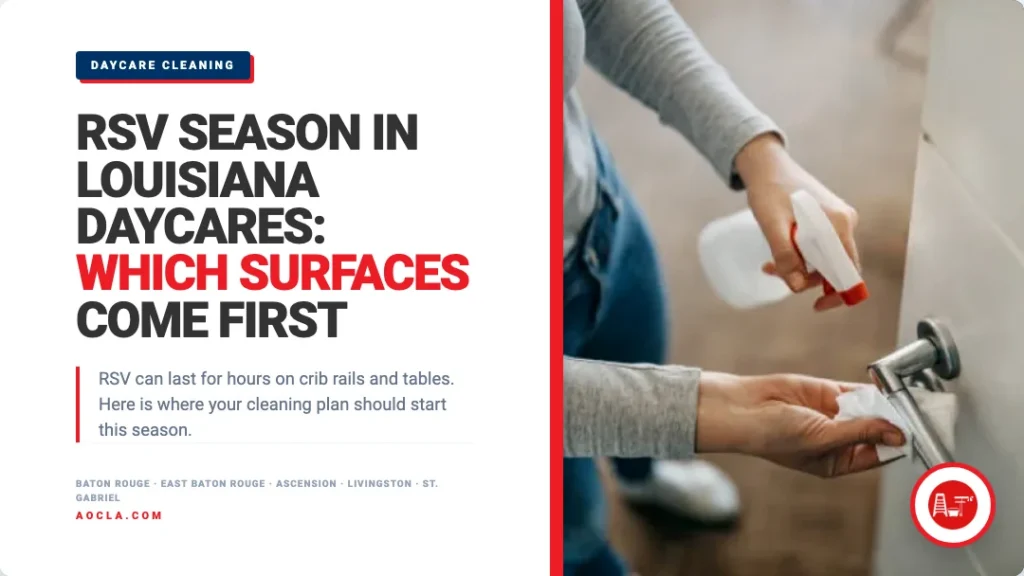
During RSV season, clean the hard surfaces children touch with their hands and faces first: crib rails, cots, mats, tables, high chair trays and toys that go in mouths. CDC says RSV can survive for many hours on hard surfaces like tables and crib rails. Then cover shared handles and devices, and keep up the daily cot and crib sanitizing Bulletin 137 already requires.
TLDR:
- RSV spreads through coughs and sneezes, direct contact, and contaminated surfaces, according to CDC.
- CDC says RSV can survive for many hours on hard surfaces like tables and crib rails, and for less time on soft surfaces.
- Nearly all children get RSV before their second birthday, and childcare centers are a common place to catch it.
- Louisiana’s Bulletin 137 already requires cots, cribs and mats to be sanitized daily.
- Clean first, then sanitize or disinfect. CDC calls for disinfecting when someone is sick.
- Some infants can spread RSV for 4 weeks or longer, so a stepped-up routine should outlast the first sick day.
RSV season usually starts in the fall and peaks in the winter, per CDC. For a childcare center in Baton Rouge, Gonzales or Denham Springs, that lines up with the stretch when doors stay shut, nap rooms fill up and every runny nose seems to find its way onto a crib rail.
A daycare cleaning plan built for the rest of the year does not have to be thrown out. It needs a clear order of priority. This guide lays out which surfaces to clean first during RSV season, using CDC guidance and the rules Louisiana already puts on licensed early learning centers.
Want a cleaning scope built for RSV season?
Advanced Office Care has cleaned Baton Rouge facilities since 2006, including childcare centers. We will walk your center and map out which surfaces get attention first, and how often.
What Makes RSV a Surface Problem
RSV is a respiratory virus, but surfaces are part of how it moves through a classroom. Knowing how it spreads tells you where to spend cleaning time.
According to CDC’s page on how RSV spreads, the virus moves when an infected person coughs or sneezes, or through direct contact like kissing the face of a sick child. It also spreads when someone touches a contaminated surface and then touches their face before washing their hands. The same page says RSV can survive for many hours on hard surfaces, such as tables and crib rails, and typically lives on soft surfaces, such as tissues and hands, for shorter amounts of time.
CDC also notes that nearly all children get RSV before their second birthday, and that children are often exposed in school or childcare centers. The Louisiana Department of Health’s RSV page adds that infants and older adults are more likely to develop severe RSV and need hospitalization. That is why infant and toddler rooms deserve the first look.
The Surfaces to Clean First During RSV Season
Not every surface carries the same risk. A useful way to plan is to sort the building into three tiers and work from the top down.
Tier 1: hard surfaces at child height. These are the surfaces children touch with their hands, mouths and faces, and the hard surfaces CDC names as places RSV survives. Crib rails, cots and mats, tables, high chair trays and toys that end up in mouths belong here.
Tier 2: shared hands-on spots. Doorknobs, cabinet handles, sink handles, sign-in tablets and classroom phones are touched by staff, parents and children all day. They connect one room to the next.
Tier 3: soft items. Bedding, cloth toys and tissues still matter, but CDC says RSV lives on soft surfaces for a shorter time. Laundering and quick disposal handle most of this tier.
| Surface | What to do during RSV season | Where the rule comes from |
|---|---|---|
| Cots, cribs and mats | Sanitize daily | Louisiana Bulletin 137, §1907 |
| Crib sheets and nap bedding | Launder at least weekly, and when soiled | Bulletin 137, §1907 |
| High chair trays | Wash, rinse and sanitize just before and right after eating | CDC early care cleaning guidance |
| Toys and feeding items children mouth | Clean, then sanitize | CDC early care cleaning guidance |
| Doorknobs, handles, tabletops | Clean regularly, and disinfect when someone is sick | CDC early care cleaning guidance |
| Phones, tablets, keyboards | Disinfecting wipes, keeping the surface wet for the label’s contact time | CDC early care cleaning guidance |
The Bulletin 137 rows are requirements for licensed centers. The CDC rows are guidance. Your licensing consultant and your Office of Public Health sanitarian are the final word on how your center applies both.
Clean First, Then Sanitize or Disinfect
The most common shortcut in a busy daycare is spraying a product onto a surface that was never cleaned. CDC is clear that the order matters.
CDC’s guidance for early care and education settings defines three separate jobs. Cleaning uses soap, water and scrubbing to remove germs and dirt. Sanitizing lowers germs to levels public health codes consider safe, and CDC says to sanitize surfaces that touch children’s mouths, such as infant feeding items and toys. Disinfecting uses stronger products to destroy remaining germs, and CDC says to disinfect when someone is sick or at higher risk of getting sick.
CDC also explains why the first step cannot be skipped: dirt on a surface makes it harder for chemicals to kill germs. During RSV season, that means a crib rail gets wiped clean before it gets sanitized, every time.
Louisiana sets its own bleach strengths and surface rules for daycares, which differ from CDC’s in places. Our guide to sanitizer vs. disinfectant in Louisiana daycares walks through those numbers surface by surface.
When a Child Goes Home Sick
A sick child going home is the point where the routine should step up, not stop. CDC’s early care guidance says to disinfect surfaces when someone is sick.
Start in the room the child used. Clean and then disinfect their cot or crib, the tables and chairs they sat at, the toys they handled and the doorknobs and handles in that room. Use a product registered for the job and follow its label, including how long the surface has to stay wet.
Then keep going. CDC says people with RSV are usually contagious for 3 to 8 days and can be contagious a day or two before they show signs of illness. Some infants and people with weakened immune systems can spread the virus for 4 weeks or longer, even after symptoms stop. A one-day deep clean does not cover that window, so the stepped-up routine in infant and toddler rooms should run for days, not hours.
Need extra help after a wave of sick days?
We can add targeted cleaning and disinfecting visits on top of your regular schedule, focused on the rooms that need it most.
Handwashing and Fresh Air: The Other Two Lines of Defense
Clean surfaces only help if hands stay clean too. RSV moves from a surface to a face through hands.
Bulletin 137 §1911 already spells this out for licensed centers. The rule lists handwashing after wiping noses, after toileting or changing diapers, before eating and after handling garbage, among other times. During RSV season, that list is the backbone of the plan. Keep soap and paper towels stocked at every sink, and empty tissue-heavy trash cans often.
CDC’s RSV page also points to cleaner air, such as bringing in fresh outside air or purifying indoor air. Talk with your facilities team about what is practical for your building, especially in nap rooms where children spend long stretches close together.
What to Ask Your Cleaning Vendor Before RSV Season Peaks
If an outside company cleans your center, RSV season is a good time to check the scope. A few direct questions will show if the plan matches the risk.
- Do you clean before you sanitize or disinfect? The answer should be yes, every time.
- Which products do you use on cots, cribs and toys? They should name the product and follow its label for those surfaces.
- Can you step up cleaning in specific rooms after illness? You want targeted visits, not a full rescheduling.
- How do you handle phones, tablets and keyboards? These need wipes and label contact times, not a wet rag.
- Do you offer electrostatic disinfection? An electrostatic sprayer coats hard-to-reach surfaces evenly. See how electrostatic disinfection works for a facility.
For the full picture of what to expect from a vendor, our school and daycare cleaning guide for Baton Rouge administrators includes a daily, weekly and monthly task matrix and a 10-question vendor checklist.
Common Questions About RSV Season Cleaning in Louisiana Daycares
These are the questions directors and facility managers ask when the respiratory season starts. Most come back to two ideas: clean first, and put the hard surfaces children touch at the top of the list.
How long does RSV last on surfaces?
CDC says RSV can survive for many hours on hard surfaces, such as tables and crib rails. It typically lives on soft surfaces, such as tissues and hands, for shorter amounts of time. That is why hard surfaces at child height belong at the top of a daycare’s RSV season cleaning plan.
Which daycare surfaces should be cleaned first during RSV season?
Start with hard surfaces children touch with their hands and faces: crib rails, cots, mats, tables, high chair trays and toys that go in mouths. Then cover shared handles, sink fixtures, tablets and phones. Soft items like bedding and tissues come last, handled by laundering and quick disposal.
How often do daycare cots and cribs have to be sanitized in Louisiana?
Louisiana’s Bulletin 137, §1907, requires cots, cribs and mats in licensed early learning centers to be sanitized daily. The same section requires routine laundering of bed coverings at least weekly. During RSV season, clean these surfaces before sanitizing, so the product can do its job.
Should a daycare disinfect after a child goes home with RSV?
CDC’s early care guidance says to disinfect surfaces when someone is sick. Clean, then disinfect the child’s cot or crib, their table and chair, the toys they used and the room’s handles. Because some infants can spread RSV for weeks, keep the stepped-up routine going for several days.
Is sanitizing the same as disinfecting?
No. CDC says sanitizing lowers germs to levels public health codes consider safe, and is used on surfaces that touch children’s mouths, like toys and feeding items. Disinfecting uses stronger products to destroy remaining germs, and is used when someone is sick. Both steps come after cleaning with soap and water.
When is RSV season in Louisiana?
CDC says that in most of the United States, RSV season generally starts in the fall and peaks in the winter, and its timing can vary from year to year. CDC tracks RSV activity on its Respiratory Illness Data Channel, which can show what is happening in your area.
About Advanced Office Care
Advanced Office Care is a family-owned commercial cleaning company serving Baton Rouge and surrounding areas since 2006, owned by Clay and Nessa Vavasseur. We clean childcare centers, schools, offices, medical facilities and churches across East Baton Rouge, Ascension, Livingston, West Baton Rouge, Iberville and St. Tammany Parishes.
Learn more about our daycare cleaning in Baton Rouge and our daycare cleaning services across the Capital Region. Questions first? Call (225) 751-7388.
Ready for an RSV season cleaning plan?
Tell us about your center. We will put the right surfaces first, set the frequency, and give you a clear quote with no surprises.